Skip to content

plumx
PlumX metrics are now available in Himmelfarb Library's Research Commons, a repository of research output for GW's Milken Institute School of Public Health, the School of Medicine and Health Sciences, and the School of Nursing.

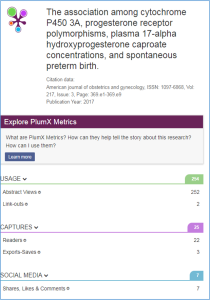
PlumX provides non-traditional  metrics  like Altmetric (social media shares, mentions, etc.), as well as more traditional metrics including  citation indexes. PlumX provides information about what's happening with research post-publication including usage, captures, mentions, social media, and citations.

To get an idea of what PlumX can tell you about an article, check out this article by GW faculty published last year and mouse over the PlumX Metrics button on the right side of the screen:
 
 
If you have questions regarding the Research Commons, please contact Meaghan Heselden (corbettm@email.gwu.edu).

GW-Nursing_logo_homepageA new Doctor of Nursing Practice (DNP) Project Repository recently was developed by the School of Nursing in collaboration with Himmelfarb Library's Research Commons.

The DNP Project Repository archives all doctoral projects completed within GW’s DNP program. It is used to advance nursing practice by preserving, archiving, and sharing these projects in a permanent digital archive even after student graduation. In addition, the repository can assist current and future DNP students in developing their own projects.

The repository is an open-access site that is searchable and discoverable via search engines.  Students retain copyright of their work and receive a unique, persistent URL that can be shared with colleagues and added to their CV/resume.

The DNP Project Repository was pilot tested in October 2017 with several 2017 DNP graduates. The Repository has now gone live and DNP students graduating in May 2018 are in the process of submitting their projects.

Be sure to check them out at hsrc.himmelfarb.gwu.edu/son_dnp/.

policymapPolicyMap is now available via Himmelarb Library!
PolicyMap allows users to create maps by combing access to a data library with mapping and reporting tools.  PolicyMap provides access to more that 150 data sources and also allows users to upload their own data.  Users can then create maps, generate reports, and run analytics.
To learn more about PolicyMap, you can look at PolicyMap YouTube Channel or check out tutorials including:
  • Maps: easily display data using different geographic parameters
  • Tables: View data as a bar graph or chart to compare multiple geographies
  • Reports: Run reports for predefined geographic areas or create a custom area
  • 3-Layer maps: Find areas that meet up to three criteria for site selection or to locate hot spots
  • Data loader: updaload your own address-level data
  • Data download: download PolicyMap data for use in your research
PolicyMap is available from on- and off-campus locations.  Off-campus users can access PolicyMap via either VPN or web-based login.  If you have questions, please contact Laura Abate (leabate@gwu.edu).

dmpappDownload the DynaMed Plus app to your phone to have up-to-the-minute access to clinical and drug information.   
DynaMed Plus is available as an app as well as online, featuring both desktop and mobile-optimized interfaces.  
 
To download the DynaMed Plus app:
  1. Access DynaMed Plus then select the link Get the DynaMed Plus Mobile app and enter your email address
  2. Download the DynaMed Plus app from iTunes or Google Play.
  3. Open the email on your phone/device, then click on the authentication key in the email to install the information in DynaMed Plus.
DynaMed Plus' clinical library gives you access to:
  • Overviews and Recommendations - concise, accurate overviews for the most common conditions as well as evidence-based recommendations for action.
  • Daily Updates – New evidence is added to DynaMed Plus multiple times each day, ensuring you always have the most current information.
  • Specialty Content – robust coverage of specialty content including critical care, infectious disease, cardiology, oncology and emergency medicine.
  • Micromedex® Clinical Knowledge Suite drug content includes medication management and lab recommendations, including IV screening, medication advisory screening and summary drug information.
  • Graphics and Images comprise more than 4,700 medical graphics and images with over 1000 images from the American College of Physicians.
If you have any questions about DynaMed Plus or the app installation, please contact Laura Abate (leabate@gwu.edu).

lexicompIt’s time to renew (or install) your Lexicomp app!
Lexicomp is a comprehensive clinical drug information app  including Lexi-Drugs, a drug interaction tool, and an extensive library of clinical calculators.  Lexicomp is available both via web access and as an app that you can install on your phone, iPad or other handheld device.

The Lexicomp app is free and Himmelfarb Library’s subscription allows you to install Lexicomp‘s high-quality drug information to your phone, iPad or other handheld device.

Lexicomp App Renewals

  1. Access Lexicomp and click on the link on the right-hand menu for ‘Mobile App Access.’
  2. Select your platform (e.g. iOS or Android) and new or existing account, then make a note of the authorization code provided.
  3. Access  http://www.lexi.com/account/code and login with your Lexicomp login/password.
  4. In the Subscriptions section, locate Add a Subscription by Code and enter the authorization code.
  5. On your phone/iPad/handheld, open the Lexicomp app and select ‘Update’.

Lexicomp New Users

  1. Access Lexi-Comp and select the right-hand menu for Mobile App Access.
  2. Select the iPhone/iPod Touch/iPad platform and that you are a new customer; copy the authorization code displayed in red. You can copy directly from your iPad by holding your finger on the code and selecting copy from the pop-up menu.
  3. Create a personal Lexicomp account then login to your Lexicomp account.
  4. Under Add a Subscription by Code, paste or type the Lexicomp authorization code.  To paste, hold your finger in the desired location and choose Paste from the pop-up menu.
  5. On your iPad, open Lexicomp and login with your Lexicomp login/password; Lexicomp content will automatically load to your iPad.

You can find additional clinical apps on Himmelfarb Library’s App Shelf. Please contact Laura Abate (leabate@gwu.edu) with questions.

rwnewOver the past month or so, RefWorks (new) has experienced issues with some of its options for creating in-text citations.  At present, the Google Docs Add-In has been fixed and is working correctly.  WriteNCite for Macs and WriteNCite for PCs are also both working and are the preferred options.  
 
Here’s the current status of in-text citation options for RefWorks (new):
  • Google add-in: this has been fixed and is working appropriately.

  • RefWorks Citation Manager (RCM) is highly problematic and should only be used for Mac Office 2016 users. For Mac Office 2016 users, RefWorks recommends writing the document as unformatted text (i.e. don’t run Track Changes) and creating a second document for tables, images, etc. After you’ve finished using Reference Citation Manager, create a document which combines the text and other materials and uses document templates, if needed.

  • WriteNCite for Mac: functional; available if users still have Word 2011.

  • WriteNCite for PCs : functional (works with most modern versions of Office including 2016)

  • QuickCite works but the user must manage the in-text citations so not useful for numbered citation styles – e.g. AMA

For RefWorks (legacy), WriteNCite for Macs and PCs is functional.  One Line/Cite is also functional works for Mac Office 2016 users.

We will continue to track these issues and will provide additional information as the issues are addressed.

policymap
Please provide your feedback on PolicyMap before the trial expires at the end of February!  We are particularly interested in if and how you might use PolicyMap to support teaching and research.
Himmelfarb Library has a trial during February for PolicyMap.  

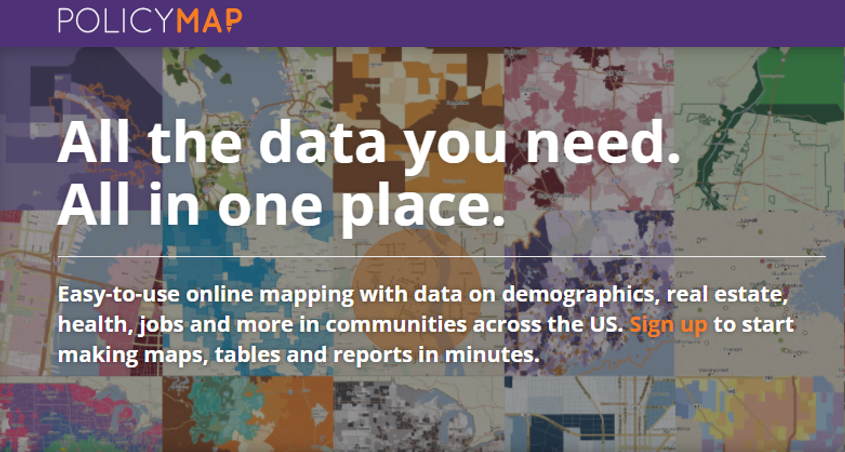
PolicyMap offers easy-to-use online mapping with data on demographics, real estate, health, jobs and more in communities across the US.    Here's a sample of what you can do with PolicyMap:

Instructors may also want to consider how PolicyMap could be used in instruction.   One example is provided by Dr. Anne Hewitt from Seton Hall University who uses PolicyMap with her students to analyze vulnerable populations.
 
You can access PolicyMap from on-campus locations or from off-campus locations via GW's VPN.
 
Please provide feedback on PolicyMap to Laura Abate (leabate@gwu.edu)!

rwnewRefWorks (new) is experiencing issues with some of its options for creating in-text citations.  WriteNCite for Macs and WriteNCite for PCs are both working and are the preferred options.  Here's the current status of in-text citation options for RefWorks (new):
  • Google add-in: this is currently not functional and should not be used.

  • RefWorks Citation Manager (RCM) is highly problematic and should only be used for Mac 2016 users. For Mac 2016 users, RefWorks recommends writing the document as unformatted text (i.e. don't run Track Changes) and creating a second document for tables, images, etc. After you've finished using Reference Citation Manager, create a document which combines the text and other materials and uses document templates, if needed.

  • WriteNCite for Mac: functional; available if users still have Word 2011.

  • WriteNCite for PCs : functional (works with most modern versions of Office including 2016)

  • QuickCite works but the user must manage the in-text citations so not useful for numbered citation styles - e.g. AMA

For RefWorks (legacy), WriteNCite for Macs and PCs is functional.  One Line/Cite is also functional works for Mac 2016 users.

We will continue to track these issues and will provide additional information as the issues are addressed.

policymap

Himmelfarb Library has a trial during February for PolicyMap.  

PolicyMap offers easy-to-use online mapping with data on demographics, real estate, health, jobs and more in communities across the US.    Here's a sample of what you can do with PolicyMap:

Instructors may also want to consider how PolicyMap could be used in instruction.   One example is provided by Dr. Anne Hewitt from Seton Hall University who uses PolicyMap with her students to analyze vulnerable populations.
You can access PolicyMap from on-campus locations or from off-campus locations via GW's VPN.
Please provide feedback on PolicyMap to Laura Abate (leabate@gwu.edu)!

pharmacogenomics-2316521_960_720

  • Is this drug more effective for individuals with a specific genetic profile?  
  • Are some people at increased risk of a serious drug reaction from a specific drug?  
  • How is pharmacogenomic information being used clinically right now?

Pharmacogenomics: Precision Medicine and Drug Response, a new CME review article from the Mayo Clinic Proceedings, explores these issues.  This article provides a brief history of pharmacogenomics, information on current clinical applications, and conceptualizes the future of pharmaceogenomics.

This article is available online via ClinicalKey which is part of Himmelfarb Library's online collection.  To read more about genetics, check out these full-text e-books in ClinicalKey

To explore more genetics topics, check out Dr. Charles Macri's online Genetics Journal Club!