Skip to content

questionsHimmelfarb Library provides access to multiple question banks to support your study for USMLE exams or to help you master material in your regular coursework.  These question banks generally require that you create a free personal account within Himmelfarb Library's account.  Your personal account will let you create your own sets of questions/quizzes and will help you track your progress on specific topics.
 
AccessMedicine

 
Includes:   Practice questions with answers to prepared for USMLE Step 1, Step 2 CK, and Step 3. Customization features allow users to select topic coverage and number of questions and to annotate exam questions/answers.
To use:  Create free personal account. 

If you have questions, please contact Laura Abate (leabate@gwu.edu).
Image citation: Youngson, N. (No date). Questions. Available from Alpha Stock Images - http://alphastockimages.com/

treelightsHimmelfarb Library's Holiday Hours:

Friday, December 21, 2018 Closing at midnight
Saturday, December 22, 2018 8:00am - 6:00pm
Sunday, December 23, 2018 9:00am - 6:00pm
Monday, December 24, 2018 Closed
Tuesday, December 25, 2018 Closed
Wednesday, December 26, 2018 Closed
Thursday, December 27, 2018 Closed
Friday, December 28, 2018 Closed
Saturday, December 29, 2018 Closed
Sunday, December 30, 2018 Closed
Monday, December 31, 2018 Closed
Tuesday, January 1, 2019 Closed
Wednesday, January 2, 2019 Opening at 7:30am

We'll be back in the new year and look forward to working with you.  Happy New Year!


Image citation: Mr.TinDC. (2010). Office Holiday Trees. Retrieved from: https://www.flickr.com/photos/mr_t_in_dc/5208400984

CranialnervesHow do you learn?

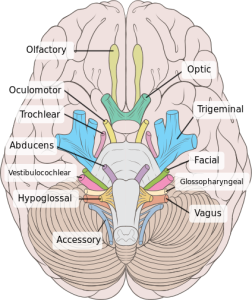
Do you know the twelve cranial nerves (of Christmas)?

A recent article in Anatomical Sciences Education explores how mnemonics and rhymes can be an important learning strategy.  Read the article to learn more about how mnemonics and rhyme relate to learning processes and neuroanatomy.  And, watch the video to learn the twelve cranial nerves of Christmas:


Image citation: Lynch, P.J. (2011). Brain human normal inferior view with labels.  Retrieved from: https://commons.wikimedia.org/wiki/File:Brain_human_normal_inferior_view_with_labels_en-2.svg

visiblebodyWant to study heart and lung anatomy?  Other aspects of human anatomy? Do you want an interactive anatomy atlas on your iPad?  Himmelfarb has the Visible Body Anatomy Atlas for you!
Visible Body Human Anatomy Atlas provides a new way to study and explore anatomy. This online anatomy atlas allows you to view specific structures and layers from head to toe, rotate anatomical models, and explore systemic and regional anatomy.

Visible Body Human Anatomy Atlas includes 5,000+ medically accurate anatomical structures and was developed by medically trained illustrators and reviewed by anatomists. This atlas allows you to explore human anatomy via multiple approaches: systemic anatomy, regional anatomy, cross sections, senses, and muscle actions.

To install, download the app from an on-campus location (or from off-campus while you have Cisco AnyConnect turned ‘on’).  To maintain access to the app,  open your Visible Body app while on-campus or  while off-campus and connected via Cisco AnyConnect at least every 150 days.

AccessMed_headerWhat is a clinician-educator? How has medicine shaped the evolution of the clinician-educator?

Emeritus faculty Larrie Greenberg describes this change in medical education from his unique perspective as an active participant in this history. In a recent article in Academic Medicine, Dr. Greenberg describes three processes which were instrumental in this process: faculty development, educational scholarship, and communities of learning.

Greenberg, L. (2018). The Evolution of the Clinician–Educator in the United States and Canada: Personal Reflections Over the Last 45 Years. Academic Medicine, 93(12), 1764-1766.

To find more articles by Dr. Greenberg and other GW faculty who engage health sciences education research, check out this bibliography which includes publications by GW faculty in the School of Medicine and Health Sciences, Milken Institute School of Public Health, and the School of Nursing.

jamaevidenceHimmelfarb Library has a resource for  you: JAMAevidence!  JAMAevidence provides access to information and tools to identify the best available evidence and to support users in the systematic evaluation of the validity, importance, and applicability of health sciences research.
    JAMAevidence provides full-text access to the most recent edition of Users' Guides to the Medical Literature : A Manual for Evidence-Based Clinical Practice as well as The Rational Clinical Examination : Evidence-Based Clinical Diagnosis and Care at the Close of Life : Evidence and Experience.    JAMAevidence also provides access to complementary resources and tools to support both teaching and learning EBM techniques including:
    • Educational slide sets on specific EBM concepts and topics
    • Interactive calculators including Therapy 2 by 2 Calculator, Risk Reduction Calculator, Number Needed to Treat Nomogram, etc.
    • Worksheets to support assessment of specific types of studies (therapy, qualitative, harm, etc.) and the information cycle
    • Audio: monthly series discussing key EBM topics
    JAMAevidence is available 24/7 from the Himmelfarb's webpage.  If you have any questions, please contact Laura Abate (leabate@gwu.edu).

    snowflakes

    The days may be shorter and the temperatures cooler, but you can still enjoy and explore DC with events and activities from Health Living @ Himmelfarb's December calendar!

    • Enjoy the lights with Zoolights or Georgetown Glow
    • Sample DC's cultural events with Winternational, the Kennedy's Center's free Messiah Sing-A-Long, or laugh through New Year's Eve with the Comedy Shuffle
    • Keep exercising (and enjoying) winter days at the Washington Harbour Ice Rink - just a short walk from Himmelfarb Library on the Georgetown waterfront

    Image: Bentley, W.A. (1885).  Snowflake Study.  Retrieved from: https://www.flickr.com/photos/smithsonian/5243239593/

    europepmcYou may be familiar with the U.S. National Library's of Medicine's PubMed search interface and PubMed Central, a free full-text archive of biomedical and life sciences journal literature - but have you heard of Europe PMC?
    Europe PMC is a repository of life sciences articles, books, patents, and clinical guidelines.  It's part of an international network of PMC repositories and includes PubMed, PubMed Central, as well as relevant records in Uniprot, European Nucleotide Archive (ENA), Protein Data Bank Europe (PDBE) and BioStudies.  Europe PMC's attributes include:
    • Single interface to search across both the citation/abstract and full-text of documents.
    • Searches PubMed and PubMed Central plus more than 5 million additional records including patents, National Health Service guidelines, and Agricola records.
    • Authors' tool to allow authors claim articles using their ORCID ID to ensure appropriate attribution of your work.
    • Grant finder tool that searches for grants from 29 biomedical funders.
    Explore  Europe PMC today!

    PolicyMap_DC_life expectancy

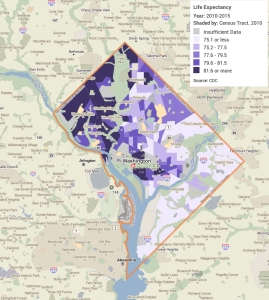
    PolicyMap now provides access to new life expectancy data from the Centers for Disease Control & Prevention.  This data provides standardized life expectancy data at census tract level, and allows identification of neighborhood-level differences in life expectancy as shown in this map of life expectancy in Washington, DC using CDC data on 'Life expectancy at birth, as of 2010-2015'.

    Learn more about this data and PolicyMap functionality via PolicyMap's article Knowing Life Expectancy to Improve Public Health.


    Himmelfarb Library provides access to  PolicyMap  .  To learn more about PolicyMap, please ask us, review the PolicyMap YouTube Channel, or check out tutorials including:


    • Maps: easily display data using different geographic parameters
    • Tables: View data as a bar graph or chart to compare multiple geographies
    • Reports: Run reports for predefined geographic areas or create a custom area
    • 3-Layer maps: Find areas that meet up to three criteria for site selection or to locate hot spots
    • Data loader: updaload your own address-level data
    • Data download: download PolicyMap data for use in your research


    lawpolprecmed
    How do law, policy, precision medicine and health equity relate to one another?  A free webcast conference on November 29 will explore these issues; participants may also register for free in-person attendance.
    Law, Genomic Medicine & Health Equity: How Can Law Support Genomics and Precision Medicine to Advance the Health of Underserved Populations? will explore how to ensure that the promise of precision medicine is fulfilled across all populations and that it doesn't recreate or exacerbate health disparities.  This conference will feature speakers including clinicians, scientists and activists to explore the intersection of law, policy, genomics, and health disparities.
    To learn more about genetics topics, participate in the GW SMHS’s online Genetics Journal Club.