In 1987, the United States established Developmental Disabilities Month with the goal of celebrating the talents and skills of those with developmental disabilities as well as highlighting the issues they face.
But what is a developmental disability? According to the National Library of Medicine’s Medical Subject Headings (MeSH), developmental disabilities are “disorders in which there is a delay in development based on that expected for a given age level or stage of development.” These conditions are quite common; the CDC states that 1 in 6 children ages 3-17 have a developmental disability. Some examples of developmental disabilities are hearing loss, vision impairments, autism spectrum disorders, and learning disorders.
The National Association of Councils on Developmental Disabilities runs an awareness campaign every year to mark the month. This year’s campaign is called “We’re Here All Year,” which is meant to promote that awareness and support for people with developmental disabilities should take place throughout the year, not just in March. The campaign is currently seeking photos of individuals working, attending school, volunteering, etc., as part of their everyday lives to showcase in a photo gallery later in the year.
One of the many ways to support people with developmental disabilities is to improve accessibility in our own work. To mark this month, we here at Himmelfarb have provided a short but non-exhaustive list below of accessibility tools and websites that can help ensure information is equitable for everyone.
Color Contrast Checker: If someone is colorblind or has a visual impairment, colors that are too alike in tone can be harder to read. Using online color contrast checkers like this one, you can ensure your graphics and PowerPoints are easier to read.
Captions: Making a video or a TikTok? Add captions to allow people with hearing loss to enjoy your video, too.
Digital Accessibility: When someone has a visual impairment, they may use a screen reader to read content online. Formatting choices that you can make in your own documents will make them as accessible to screen readers as possible. GW has best practice guidelines for making PDFs accessible along with other web-based content.
Language Matters: Some terms used to speak about those with disabilities are based in painful history. Take some time to learn common terms that are used by these communities and how they should be used. When it comes to individuals, ask them what they prefer. https://www.ndrn.org/resource/communicating-about-people-with-disabilities/
Test Proctoring Services and Notetaking: GW disability support services can provide test proctoring services or notetaking services for students registered with them.
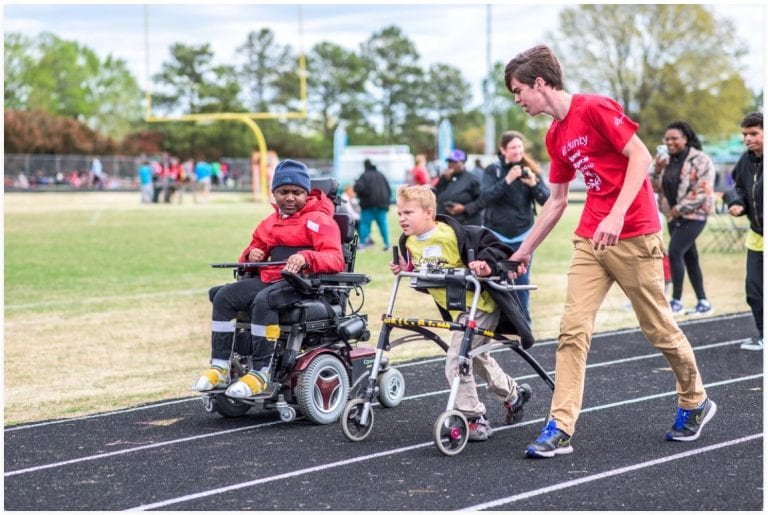
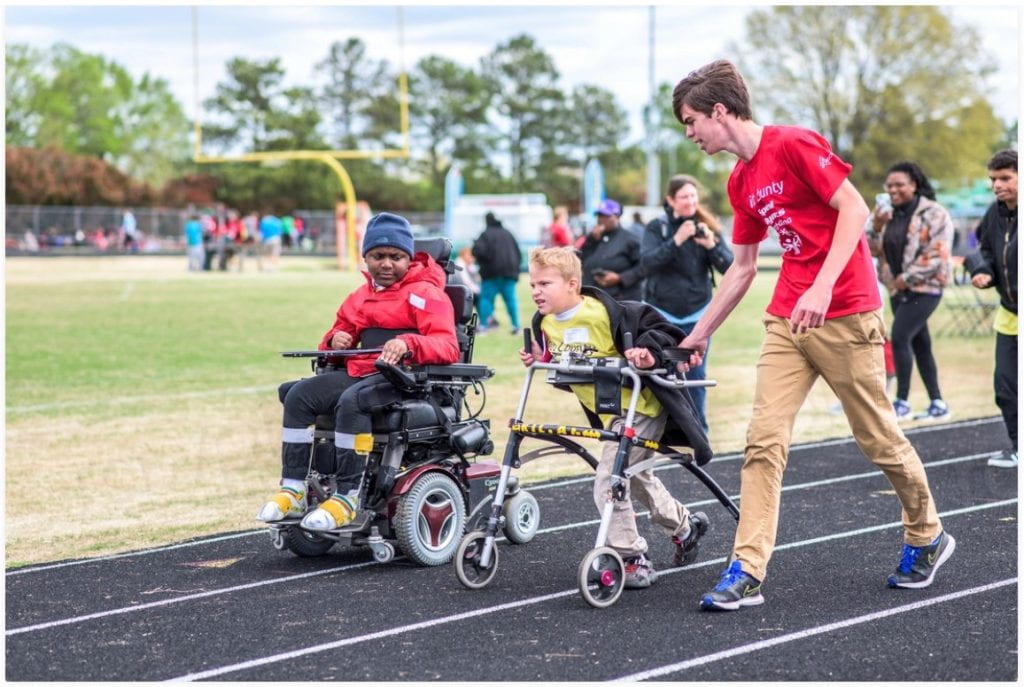
2017 Special Olympics Spring Games Photo by Aaron Hines (public domain image)
Students at GW are doing great things both in the classroom and outside of it. For our ongoing series of spotlights on student organizations, I spoke with Arinze Okeke and Nikki Karri, both of whom are first-year med students, and also the co-presidents of KEEN at GW.
KEEN stands for Kids Enjoy Exercise Now, and the chapter at GW is part of a larger organization which has provided free programs for fitness and recreation for youth with disabilities since 1992.
Volunteers from GW, who are known as coaches, sign up on KEEN’s email list, and then volunteer one of three Saturdays a month to help out with the program. KEEN invites youth between the ages of approximately ten and 20 years old with all types of disabilities to come to a gym or pool and be paired with a coach or coaches. Students from GW’s KEEN chapter, as well as other area universities, serve as coaches for the activity selected by each young participant.
Arinze explained how participants join the KEEN program: “To get involved, kids fill out a profile stating their likes and dislikes, what activities calm them down, and what they like to do for fun. Sometimes their parents are involved in helping complete the profile.”
Nikki explained how coordination occurs between the coaches and the participants in KEEN, who are known as athletes. “After we recruit our coaches, we work with the KEEN Greater DC area program director, who’s in charge of both us as coaches, and also the athletes.” KEEN provides a list of athlete abilities and activity preferences, based on the first-hand account collected in the athlete questionnaire. “Beth [KEEN’s program director] knows us and the athletes, so she’ll pair us up based on how well she thinks we’ll fit.” With newer coach volunteers, Nikki continued, “Beth will pair them with the athletes she thinks will be a good fit.” Each Saturday session lasts three hours, during which coaches cycle through working with different athletes and different age groups on an hourly basis.
The range of disabilities represented by KEEN athletes is wide, Nikki reported. “Some of them are nonverbal, and a lot of them have intellectual or physical disabilities.”
Once athletes have been matched with a coach, Arinze says, “We hang out with them, play sports with them – whatever they want to do for the hour we’re together.” Nikki elaborates, “Athletes are new to the activities, and they can try things out. While our involvement is solely with coordinating volunteers for the sport and swim activities, KEEN is not only sports. There are different activities offered throughout the week.”
Before each session, the coaches gather, and Beth or one of her coordinators will hand coaches their papers. Arinze describes what happens next: “We have some time to read through the first-hand account of each athlete’s characteristics, and maybe talk to other coaches who’ve worked with them. Because typically there are people who have worked with them before, who know their likes and dislikes.”
I asked Nikki whether there is a constant flow of new athletes joining KEEN. “Most are repeat athletes. Some of them even come with their siblings, so that’s very fun. And there are people who won’t come on a given week and then you see them later and say, ‘Oh my gosh, I missed you!’” Occasionally new athletes also join the program.
In terms of coach volunteers, Nikki explained that a maximum of ten students can sign up for each weekend’s session, in order to ensure a correct ratio of coaches to athletes. “Depending on whether it’s a heavy week with tests and stuff, sometimes we’ll have six or eight people, but sometimes if it’s a test-heavy week it will be [fewer].” Arinze says that the ratio of coaches to athletes is either one on one, or sometimes more than one coach is assigned to an athlete.
Coaches participating in KEEN come from GW and other area universities. Arinze has met KEEN coaches from Howard University’s medical school. Additionally, coaches from area schools may come from undergraduate programs and disciplines other than medicine.
I asked Arinze and Nikki what drew them to becoming involved with KEEN. For Arinze, mentorship is something he has always been drawn to. During his gap year, he had a unique opportunity to be a second grade special education teacher in Southeast DC. He appreciated “being able to spend time with the kids I had on my caseload, day in, day out, [understanding] what each of them specifically learns, what each of them specifically needs to flourish, because it will look different from the full class, but it will also look different across each individual kid on the caseload.”
Arinze found it rewarding to learn “the small things that make a huge difference in the kids’ learning, their confidence, and their experience of school itself.” Having a disability of any type, he reflected, “can get really discouraging. You can get down on yourself. So I was really glad that I was able to encourage them through the process.”
The mentorship aspect is also one that drew Nikki to become involved with KEEN. Throughout high school and her undergraduate studies, she had volunteered working with the elderly at a nursing home. Eventually, she made the transition to working with children, “doing equine and hippotherapy – working with kids and horses.” She saw how their interactions helped make kids’ days better, and shaped and improved their overall well-being.
In terms of their involvement with KEEN and its influence on their eventual choice of specialty, Nikki said that working with KEEN “pushed me towards pediatrics. I’m between peds and other fields, but I think KEEN really solidified my choice of peds as one of my top contenders.” Arinze is thinking about family medicine: “That would incorporate working with kids and adults. Just because I definitely feel drawn to the mentorship aspect, being a positive adult influence is important.”
While some other KEEN coaches are interested in pediatrics, Nikki says, the activity is also a draw for students because it carves time out of the week to “do sports, do something completely different than medicine, but still being able to use your skills and build your people skills.”
In terms of what KEEN’s co-presidents are looking for in potential coaches, Arinze emphasizes, “Just being interested in helping the kids is what we need. Being interested and enthusiastic is what we’re looking for at KEEN.” Nikki adds, “All coach volunteers are provided training prior to their first session. We are open to everyone – be self-motivated and willing to help.”
Elizabeth Ware Packard - Packard, born in Massachusetts in 1816, was needlessly committed to asylums twice in her life. At 19 her father sent her to an asylum in Worcester when she suffered from what was called “brain fever”. She believed the treatment she received made her symptoms worse. At the time asylums were “a quasi-prison, ruled by a psychiatric director”(Himelhoch, 1979). Patients had no rights to know their diagnosis, refuse treatment, or leave. As a middle-aged woman with six children, her husband committed her a second time when their religious beliefs diverged and she began to practice missionary and religious work outside the home. Though due process was required to institutionalize a man, husbands could commit wives without any evidence of mental illness. After three years at the Illinois Hospital for the Insane and a court case where she sued her husband for imprisoning her in their home after her release, Packard devoted the rest of her life to advocate for the rights of married women and the mentally ill through lectures, lobbying, and publications. Thanks to her work Illinois repealed the law that allowed women and children to be committed without due process safeguards; Iowa, Maine, and Massachusetts allowed visiting teams to assess conditions in their asylums; and, in Iowa, “Packard’s Law” made it illegal for asylum patients’ mail to be interfered with.
Learn more about Elizabeth Ware Packard at:
Brandman, Marianna. (2021). Elizabeth Packard. National Women’s History Museum.
Himelhoch, Myra Samuels, and Arthur H. Shaffer. (1979). Elizabeth Packard: Nineteenth-Century Crusader for the Rights of Mental Patients. Journal of American Studies 13.3, 343–375 https://www.jstor.org/stable/27553740
Agatha Tiegel Hanson - Hanson was born in Pittsburgh in 1867 and became deaf and blind in one eye at 7 years of age after a case of spinal meningitis. She attended the Western Pennsylvania School for the Deaf and was one of the first women enrolled in the National Deaf-Mute College which became Gallaudet University. The success of her women’s debate group pushed the college president to lift his ban on women’s organizations on campus and she helped establish the Phi Kappa Zeta Society. She was the only woman to graduate in 1893 and the first woman valedictorian at the college. In her commencement address, “The Intellect of Women”, she argued against the structural inequalities women faced. After graduation, she taught, wrote poetry and newspaper articles, and was a community activist in Seattle with her deaf husband Olof. Gallaudet’s Hanson Plaza and Dining Hall are named in her honor.
Johnnie Lacy - Lacy was born in Louisiana in 1937 and moved to California when she was 10. She contracted polio during a practicum as a 19-year-old nursing student and became paralyzed. When she applied to a speech therapy program at San Francisco State as a wheelchair user in 1980, she was at first denied admission due to her disability. After asserting her rights under the Rehabilitation Act (the only federal protection for disabled persons at the time) she was admitted but was not allowed to participate in graduation ceremonies. She co-founded the Berkeley Center for Independent Living and was an early activist in the independent living movement. As a Black woman, Lacy advocated at the intersection of race and disability at a time when most who were prominent in the movement were white.
Barbara Faye Waxman Fiduccia - Waxman was born in Los Angeles in 1955. Both Barbara and her brother Michael were born with spinal muscular atrophy, a hereditary disorder that causes progressive muscular weakness. She used an external ventilation system most of her life. Waxman graduated from California State University, Northridge with a degree in psychology and worked for Planned Parenthood and the Los Angeles Regional Family Planning Council as a sexual health educator and counselor. She advocated for the reproductive rights of disabled persons, authoring many publications on the topic. She and her husband who was also disabled fought to protect their right to be married without losing their Medicaid and Medicare benefits and provided testimony to a congressional committee about it in 1994. Tragically, Waxman died a few days after her husband in 2001 when her ventilator malfunctioned. Disability rights advocates are still fighting to do away with “the marriage penalty”, most recently in the form of HR6405.
Each year the indexing team at the National Library of Medicine (NLM) updates descriptors and makes new headings available for searching in PubMed, MEDLINE, and other NLM databases. The 2024 changes were applied in December 2023. You can see new descriptors and changed descriptors on the NLM site.
There were changes to headings for Influenzavirus A (now Alphainfluenzavirus) and Respiratory Syncytial Virus (three new entry terms for Chimpanzee Coryza Agent, Orthopneumovirus, and RSV Respiratory Syncytial Virus that will map to the heading when searching). Voting became a new MeSH heading. And there was a large expansion of terms available for concepts related to Psychological Stress - 54 to be precise! For example, you can now explode Coping Skills to cover nine concepts including Behavioral Coping and Cognitive Coping.
Other new terms include some coming out of the pandemic (immune system exhaustion, mental health teletherapy, pandemic preparedness, unvaccinated persons), some that are DEI-related (deaf culture, disability discrimination, social genomics, and undertreatment), and others that invite a visit to the scope note to see what they are all about (flighted spongy moth complex?)
Changes and new headings are not retrospective. For example, if searching for Influenzavirus A you will need to search the new Alphainfluenzavirus heading and the previous Influenzavirus A heading to get both new and older publications. To search for Voting prior to 2024 you may want to consider using the broader heading Politics which the concept was included under previously.
For precision searching with MeSH headings, NLM encourages you to consult the MeSH Browser for scope notes and other information about a term. It can guide you to the right headings, subheadings (see the Qualifiers tab), and entry terms. Entry terms function like cross references so searching RSV will include the publications indexed for Respiratory Syncytial Virus since it’s an entry term for that heading. If you don’t want entry or mapped terms to be included, use double quotes to limit your search to just that precise heading.
NNLM will be offering a free webinar on MeSH Changes and PubMed Searching on January 25th from 1 to 2:30pm. You’ll hear more about the changes and have an opportunity to practice searching in PubMed. The class is available for beginner through advanced searchers.
December is Universal Human Rights Month and this past Sunday (December 10th) was the 75th commemoration of the adoption of the Universal Declaration of Human Rights by the UN. The declaration was formed three years after the ratification of the United Nations charter. In the wake of the horrors of World War II there was a strong impetus to establish both a peacekeeping body and an agreed set of fundamental human rights to be universally protected.
Among the rights in the declaration are:
All human beings are born free and equal in dignity and rights.
Everyone has the right to life, liberty and security of person.
No one shall be subjected to torture or to cruel, inhuman or degrading treatment or punishment.
All are equal before the law and are entitled without any discrimination to equal protection of the law.
There are over 30 articles in the declaration, ensuring freedom of movement, right to asylum, right to education, freedom of peaceful assembly, freedom of opinion and expression, freedom of religion, and right to privacy among others. It recognizes the right to marry and equal rights and dignity in employment. Article 25 specifically addresses the right to medical care:
“Everyone has the right to a standard of living adequate for the health and well-being of himself and of his family, including food, clothing, housing and medical care and necessary social services, and the right to security in the event of unemployment, sickness, disability, widowhood, old age or other lack of livelihood in circumstances beyond his control. (United Nations, 1948)”
The United States is a signatory to the Declaration. Despite this, our government does not always live up to the ideals of the document. The structure of the health care system in the US does not support the standard of universal care guaranteed in Article 25 and the US has failed to ratify most of the international treaties that include a right to health (Willen, 2019). FDR advocated a Second Bill of Rights to include the right to “adequate medical care and the opportunity to achieve and enjoy good health” in his 1944 State of the Union. President Truman was also an advocate of a national health insurance program tied to Social Security. But in the 1940’s private health insurance became more common in the US, covering about half of the population, and the insurance industry created a barrier to further proposals for a national health program at the federal level (Berkowitz, 2005).
The Johnson administration established Medicare and Medicaid in 1965 after a many years long fight and negotiation with the insurance industry. It was largely successful because it covered vulnerable populations who typically were too high risk to be privately insured. For decades many Americans fell through the gaps between the coverage of those programs and private insurance.
While the Affordable Care Act of 2010 brought affordable health care to millions more, the country still fails to provide care to everyone and the current complex system of public and private funding increases inefficiencies and costs. A post pandemic study documented how our “fragmented and inefficient health care system” cost over 200,000 more lives and billions more in expenses during the Covid pandemic than a single payer system would have (Galvani, et al. 2022). A 2022 survey published by KFF (formerly Kaiser Family Foundation) estimates that 41% of adults currently have some debt as a result of medical or dental treatment and one in 10 has significant medical debt. A quarter say they have debt that is past due or that they are unable to pay. One in four black adults, lower-income adults, and uninsured don't think they will ever pay off their health care debt.
However it is achieved, further progress in health care reform is necessary to provide the universal coverage all Americans deserve and reduce the costs and inefficiencies that are negatively impacting the delivery of healthcare in the US.
Sources
Berkowitz E. (2005). Medicare and Medicaid: the past as prologue. Health care financing review, 27(2), 11–23.
Galvani, A. P., Parpia, A. S., Pandey, A., Sah, P., Colón, K., Friedman, G., Campbell, T., Kahn, J. G., Singer, B. H., & Fitzpatrick, M. C. (2022). Universal healthcare as pandemic preparedness: The lives and costs that could have been saved during the COVID-19 pandemic. Proceedings of the National Academy of Sciences of the United States of America, 119(25), e2200536119. https://doi.org/10.1073/pnas.2200536119
Willen S. S. (2019). Invoking Health and Human Rights in the United States: Museums, Classrooms, and Community-Based Participatory Research. Health and Human Rights, 21(1), 157–162.
Would you like to learn more about healthcare related disability and accessibility issues? Would you like to hear perspectives from disabled individuals as they discuss how their disability impacts their lives? The Disability Visibility podcast, hosted by Alice Wong, has one hundred episodes that center disabled individuals and activists who work to create a more accessible world.
If you are interested in listening to the podcast, Himmelfarb Library’s DEI Committee suggests starting with episodes 95 and 98. In episode 95, Alice Wong speaks with Dr. Justin Bullock, an African-American medical resident who wrote the New England Journal of Medicine article Suicide–Rewriting My Story. The episode’s conversation focuses on Dr. Bullock’s experiences with Bipolar Disorder, suicidality and his medical school and residency journey. Episode 98 is another conversation with UC Berkeley undergraduate student, Alena Morales. Morales shares her experiences with creating the Disability Cultural Center on Berkeley’s campus and what that process taught her about creating communities for disabled people.
If you listen to the suggested episodes and would like to hold a community discussion, the DEI Committee created a starting list of questions that may guide the conversation:
Did this podcast change your perspective on disability? What surprised you?
If you or someone you know has disabilities, what challenges have you/they faced?
How does disability intersect with other identities such as race or sexual orientation?
Are you aware of ways that GW accommodates students with disabilities? What else could be done?
Dr. Bullock discusses his experience with bipolar disorder. Had you considered mental health issues as disabilities? In what ways are these disabilities similar to and different from a physical disability?
The Disability Visibility podcast is one part of the ongoing Disability Visibility project. To learn more about the podcast or the larger multimedia project, visit the project’s website at disabilityvisibilityproject.com. If there is a DEIA resource that you would like to share with the committee, please contact the current chair, Rachel Brill at rgbrill@gwu.edu.
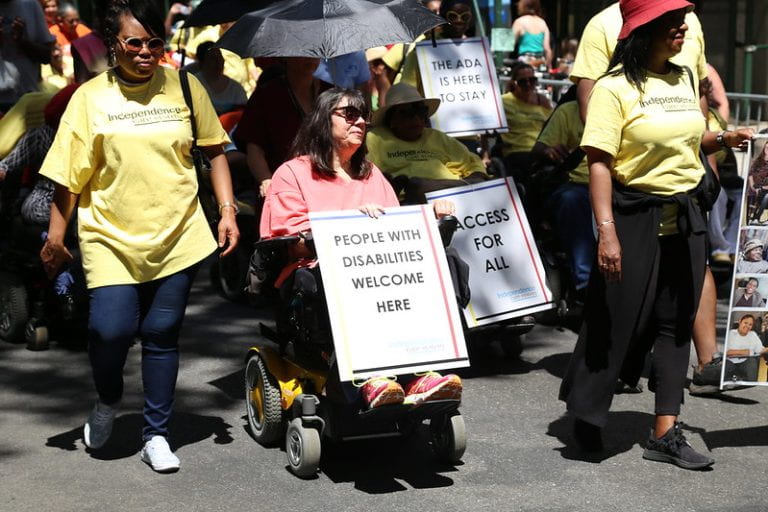
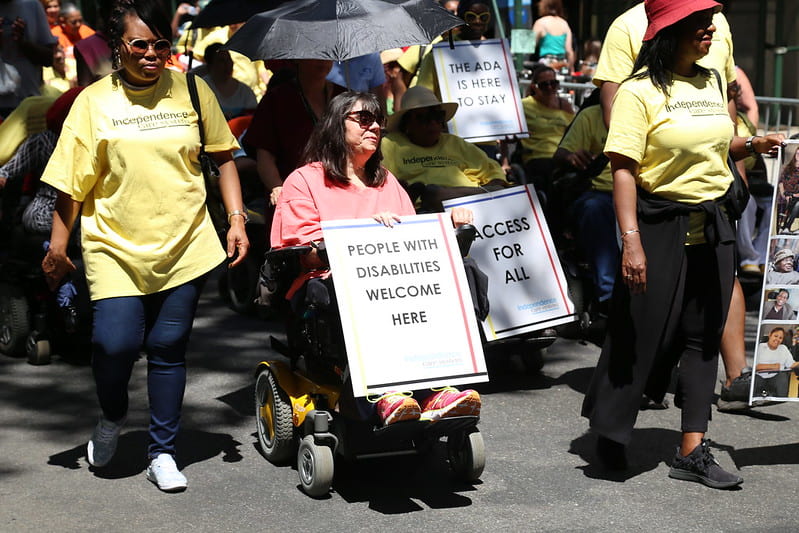
July 26, 2023, marks the 33rd anniversary of the passing of the Americans with Disabilities Act (ADA). Signed into law by President George H.W. Bush on July 26, 1990, the ADA is a civil rights law that prohibits discrimination against disabled persons and helps ensure that disabled people have the same rights and opportunities as the general public (ADA National Network, 2023). The ADA guarantees equal opportunity for disabled individuals in “public accommodations, employment, transportation, state and local government services, and telecommunications” (ADA National Network, 2023).
Being Heumann: An Unrepentant Memoir of a Disability Rights Activist by Judith Heumann: This is the memoir of one of the most influential disability rights activists in US history and tells of Judith Heumann’s lifelong battle to achieve respect, acceptance, and inclusion in society. This book is available through Himmelfarb’s Consortium Loan Service (CLS).
Sitting Pretty: The View from My Ordinary Resilient Disabled Body by Rebekah Taussig: Written by disability advocate Rebekah Taussig, this essay collection is based on a lifetime of experiences in a paralyzed body and discusses the themes of identity, accessibility, bodies, and representation. You can request this title through CLS.
On July 26, 1990, President George H.W. Bush signed the American with Disabilities Act (ADA) into law which provided legal protections for disabled people. To commemorate the signing of this key piece of legislation, July 26th is known as National Disability Independence Day.
According to ADA.gov, “The Americans with Disabilities Act (ADA) is a federal civil rights law that prohibits discrimination against people with disabilities in everyday activities...The ADA guarantees that people with disabilities have the same opportunities as everyone else to enjoy employment opportunities, purchase goods and services, and participate in state and local government programs.” (U.S. Department of Justice Civil Rights Division, 2022) The ADA defines a person with a disability as someone who:
Has a physical or mental impairment that substantially limits one or more major life activities
Has a history or record of such an impairment (such as cancer that is in remission), or
Is perceived by others as having such an impairment (such as a person who has scars from a severe burn). (U.S. Department of Justice Civil Rights Division, 2022)
The ADA is split into five subsections which details the protections disabled people are given. While the ADA prevents discrimination against disabled people due to their disabilities, many disability activists remain vocal about the inequalities disabled people continue to face. For example, during the COVID-19 pandemic, many disability rights activists spoke up on how COVID safety measures were key to keeping disabled and severely ill people safe. When these measures were lifted many disabled people were unable to fully participate in society:
“Disability rights and inclusion activist Imani Barbarin started the #MyDisabledLifeIsWorthy hashtag…in response to [CDC Director Dr. Rochelle] Walensky’s Jan. 7 appearance on Good Morning America, in which the presence of underlying conditions in those who have died from COVID-19 was framed as ‘encouraging news’...That Walensky’s remarks angered so many in the disability community–who took to Twitter to speak out about feeling unprotected and unvalued at a time when opposition to mask-wearing and vaccine mandates remains considerable, and accessibility is compromised–is emblematic of nearly two years of ongoing frustration with a society that is rushing to return to business as usual while leaving high-risk individuals isolated and vulnerable.”
(Pagano, 2022)
Disability rights activists point out that accessibility features allow disabled people to engage with society and also benefits able bodied people. As disability rights activist Kings Floyd notes in their TEDx talk Lessons in Making Aging Accessible, From a Millenial: “If we cannot support the community in which we live everyday, to be able to connect, to be able to socialize, to be able to be accessible, we are not planning for our future and we are not planning for our success.” (Floyd, 2019)
Awareness. It is one thing to read about it and another to understand what it means. The beauty of awareness is that it often inspires change in our actions, thoughts and lives. March just so happens to be Developmental Disabilities Awareness month, and is a fantastic opportunity for the medical community to recognize the importance of educating ourselves and our patients when it comes to developmental disabilities.
Children develop at their own pace, but there are important milestones that should be achieved by a certain point in a child’s development. These skills are not only fundamental to a child’s growth, but if not monitored closely, long term developmental disabilities can worsen such as ADHD, autism, cerebral palsy, learning disorders, or a loss of hearing or vision. Developmental disabilities may be physical or intellectual; Intellectual and Developmental Disabilities or IDDs is the term used to describe instances when an intellectual disability and other disabilities are present.. For further reading, see what the NIH has to say about IDDs.
Ask yourself: “Is my patient developing at a rate they are supposed to?” Observation is key when it comes to treating children. Monitor your patients. If you notice an ongoing pattern, seek appropriate treatment for them.
For further information on Developmental Disabilities and what you can do to protect and prevent your patients’ symptoms from worsening, visit the CDC’s Developmental Disabilities homepage.