Skip to content

Master Teacher in the GWTeach Program, SuJin Choi identified how limited internet and hands-on learning accessibility during COVID-19 hindered D.C. Public School students, slowly creating a learning gap.

A Look Into: (CES course) The GW Teach Program 

Professor: SuJin Choi 

The GWTeach program is an academic minor that prepares students in STEM majors for teaching licensure in Washington, D.C. In courses like GTCH 1002: Inquiry-Based Lesson Design, students design, teach, and assess learning in a STEM lesson. Students engage directly in local classrooms, like McKinley Middle School and DC Preparatory Academy, mentored by a Master Teacher. 

...continue reading "Professor SuJin Choi reflects on six years in the GWTeach program"

Community Based Participatory Research (CBPR) is, “a partnership approach to research that equitably involves community members, organizational representatives, and academic researchers in all aspects of the research process. It enables all partners to contribute their expertise, with shared responsibility and ownership; it enhances the understanding of a given phenomenon; and, it integrates the knowledge gained with action to improve the health and well-being of community members, such as through interventions and policy change” (Israel, Schulz, Parker, and Becker, 1998).

The Honey W. Nashman Center for Civic Engagement and Public Service supports CBPR through faculty mini-grants, student research prizes, and professional development programs like Faculty Learning Communities (FLC).

This collection of resources is the outcome of the 2022 FLC on CBPR in Health and the 2019 FLC on CBPR Basics.

...continue reading "The Nashman Center’s Top CBPR Resources"

We are proud to announce that for the 2023-24 year, Dr. Tamara Taggart will be serving as the Nashman Center Faculty Fellow. During the coming year, Dr. Taggart will conduct community-engaged formative research (surveys, interviews, focus groups, and environmental scans) to develop an Activist in Residence (AiR) program.

Activists in Residence is a practice model that provides opportunities for activists to engage with an academic community to develop and strengthen their capacity, network, resources, and work.

...continue reading "2023-24 Nashman Center Faculty Fellow: Dr. Tamara Taggart, GWSPH"

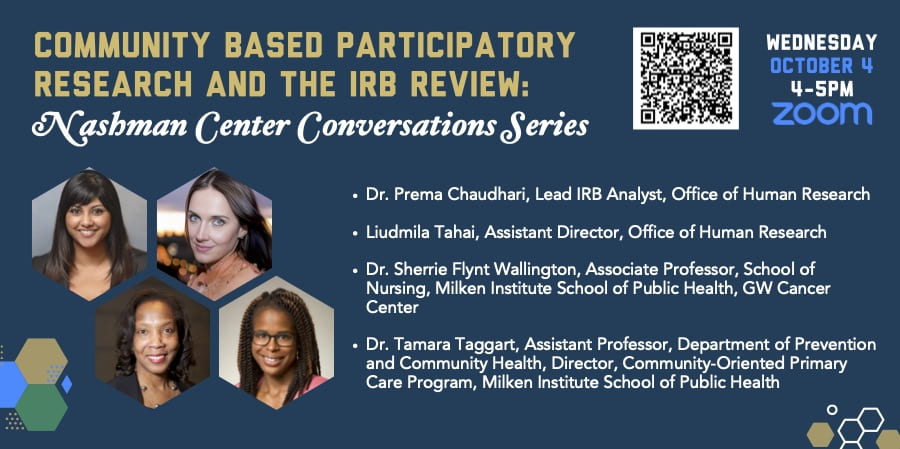
The Conversations on Community Engaged Scholarship Series is back for 2023-24.   Join us for the first event of the year:

Community Based Participatory Research and the IRB Review
Wednesday, Oct 4, 4-5pm, by zoom

...continue reading "Conversations: Community Based Participatory Research and the IRB Review"

The PAGE Fellows Program invites graduate students to participate in a yearlong working group in support of collaborative art-making, teaching, writing, storytelling, and co-creating knowledge with and within community. Apply here ...continue reading "Share With Students: PAGE Fellowship Application Deadline Approaching"

Metropolitan Universities journal updates

Recently published

Vol. 34 No. 2: The Pedagogy of Place-Based Initiatives and Anchor Institutions

Guest editors: Patrick M. Green and Susan Haarman, Loyola University Chicago

Open calls for manuscripts

Metropolitan Universities journal accepts manuscripts on an ongoing basis on scholarship and research relevant to our urban and metropolitan campuses and communities. Review our Aims and Scope for more information. Submit Complete Manuscript

Productive Tensions and Uncomfortable Conversations

Guest editors: Matthew Durington, Towson University; Katherine Feely, John Carroll University; and Jen Britton, Drexel University

Complete manuscripts due: August 1

The Coalition for Urban and Metropolitan Universities has released a new publication on "The Development of the Community Impact Feedback Questionnaire for Service-Learning: A Delphi Study".  Read the article here.  ...continue reading "Good Reads: “The Development of the Community Impact Feedback Questionnaire for Service Learning”"

Each semester at the University Writing Program's Writing Conference, the Honey W. Nashman Center for Civic Engagement and Public Service hosts a special panel of students representing community engaged writing UW 1020 courses. This event is always a great opportunity to more deeply understand how students make meaning of their service-learning experiences, adding complexity and quality to their research and writing.

The panel, held Thursday, March 2, 5-6pm, was moderated by Wendy Wagner, Director of Community Engaged Scholarship at the Honey W. Nashman Center for Civic Engagement and Public Service.

Student Panelists:

...continue reading "GW University Writing Conference: Student Panel on Community Engaged Writing"

Sponsored by LEAD California, IARSLCE (International Association for Research on Service-Learning and Community Engagement) and Imagining America, the Dissertation Dish webinar series spotlights research in the community engagement field. This webinar is on Organization Development for an Engaged Campus: Assessing Narratives and Architecture to Direct Future Change. Click here to watch.

Dr. Michelle Kelso, recipient of the 2022 Nashman Center Community Engaged Teaching Award, has many years of experience engaging her students in the community. Her own scholarship has focused on EU migration and the fate of the Roma during the Holocaust in Romania.  She recently co-authored an article on Medium on the impacts of volunteer networks in Ukraine.  Read the article here

The Coalition of Urban and Metropolitan Universities has two research fellowship applications open until November 28th for 2022-2023.  Collaboratory Research Fellow Application. Federal Reserve Bank of Philadelphia Research Fellow. The fellowships are open to students and faculty.

...continue reading "Call for Proposals: CUMU Collaboratory and Federal Reserve Bank Research Fellowships"

GWupstart is GW's central hub for social innovation training, mentoring and funding. Deadline for grant applications is November 14th 2022.  GWupstart builds on GW’s strength as an institution that fosters the next generation of citizen leaders. Approximately $75,000 in funding is available every year. In addition, we provide mentorship and support to students to turn their ideas into practical action that makes a measurable, sustained difference. Apply today

Award: 2nd Place, Nashman Center Prize for Community Engaged Research, 2022
Project: ArtReach GW at THEARC: An Observational Evaluation
Human Services and Social Justice students Abigail Care and Alexa Betances collaborated with ArtReach GW, an organization committed to community engagement within D.C., originally founded as Corcoran ArtReach at the Corcoran School of the Arts & Design in Washington, D.C. Primarily serving youth and families with mental health issues living east of the Anacostia River, ArtReach GW supplies a myriad of explorative arts programs throughout D.C. Wards 7 and 8 and art therapy services in an area that lacks mental health clinicians. Their services reached 247 participants in 2019 and 11 exhibitions, 59.6% residing in Ward 7 and 8.
The researchers designed an observational evaluation tool for art therapy practices to replicate that of an ArtReach GW class and provided instructions for future course implementation.
Read more about their research here.
Bearing in mind the cogency of self-expression and creativity, the students suggested methods of improvement within interactive peer activities based on effective group art therapy and more coherent curricular parameters.
"Using a research-based evaluation process and the research question given to us by ArtReach GW, we examined four areas of interest for the organization to assess the effectiveness of their online classes: self expression and creativity, open sharing of opinions, art skills, and visual literacy."

Award: 1st Place, Nashman Center Prize for Community Engaged Research, 2022

Project: Key Recommendations for Higher Education Institutions to Provide Non-Financial Support to Refugee-Background Students 

At the annual GW Research Showcase in spring 2022, research team Olivia Issa, Emmanuelle Dyer Melhado, and Sara Alassaf presented their research, which grounded a larger project, the Welcoming Campus Initiative. This grassroots program advocates for a more inclusive GW community for refugee-background students including a scholarship, mentorship program, and revised admissions practices.

The program was initially developed by No Lost Generation GWU (NLG) members in collaboration with refugee-background students on campus and the Student Voices for Refugees Network. Olivia Issa studied Political Science and Arabic Language at GW and helped lead refugee-advocacy groups before graduating.

This program has expanded through conversations with numerous other universities and organizations across the country, outlining proposals at schools like Georgetown University and George Mason University to start their own Welcoming Campus Initiative. The Welcoming Campus Initiative Committee is planning to continue further programming, including fundraising events and awareness projects geared to make GW an inclusive space for all.

Read more about the initiative here. Read more about the research project here.

“We worked with students internationally, including refugee-background students themselves, to interview practitioners and student recipients of college-access programs for refugees in the US, Mexico, and Canada through Student Voices for Refugees,” Issa said.

The purpose of this study was to both acknowledge the barriers sitting at the forefront for refugee-background students and bring forth recommendations to the higher education institutions to better connect these students to resources. Two categories of non-financial student assistance emerge from their research: revising admissions practices, like accepting Duolingo English tests in addition to TOEFL scores, and developing pre-arrival and on-campus mentorship programs. After realizing GW was a vital component in assuring her goals come to fruition, Issa began the Welcome Campus Initiative project to help make "life-changing education" happen.

Outlined below are some key components from Issa's research:

Community Partnership Recommendations for GW and other higher education schools
Project by the University Alliance for Refugees and At-Risk Migrants: Student Voices for Refugees Switching out standardized test requirements for low-cost English proficiency exams that schools are beginning to accept
Volunteers created toolkits for refugee-background students through scholarships and mentorship programs  Implementing an alumni mentorship networking program modeled after World University Services Canada 
Olivia Issa spearheaded practitioner-student interviews with those involved in college-access programs  Adding pre-entrance language programs and volunteer-led English tutoring like Proyecto Habesha and GirlForward