In "World on a Plate" by Professor Tara Scully, students study food history and science, while examining food industry connections to social issues like immigration, labor standards, and public health. Students learn about local implications of food systems through service with food banks, food recovery programs, and farmer's markets. This course is taught by renowned chef and humanitarian José Andrés in collaboration with the professor.
If you are interested in taking a Community Engaged Course check out this link here.
Fall 2024
Professor: Tara Scully
Students Reporting: 52
Time Reported: 521.01 hrs
Community Partners:
This semester, students in Professor Scully's SUST 3003 course engaged with multiple community organizations focused on food insecurity and sustainability in the Washington, DC area. Through their service, students gained hands-on experience with food systems while supporting vital community needs.
DC Central Kitchen: Students participated in meal preparation and packaging, chopping vegetables, organizing food items, and preparing meal trays with essential ingredients. This work supported DC Central Kitchen's mission to combat hunger and create opportunities through food.
Miriam's Kitchen: Students helped prepare and serve food for people experiencing homelessness. They worked in the dining room, assisted with meal service, and supported the organization's mission to end chronic homelessness in DC.
Bread for the City: Students stocked shelves at the food pantry, portioned produce into bags, and assisted community members in selecting groceries. This work helped ensure equitable access to food resources for DC residents facing economic challenges.
FRESHFARM: Students volunteered at farmers markets throughout DC, assisting with market operations, helping customers access FRESHFARM benefits, and supporting the Thanksgiving Food Drive. Their service helped connect local farmers with the community while promoting sustainable food systems.
Martha's Table: Students worked at the Maycroft Mini Market and other locations, organizing and distributing fresh produce to community members. Some students participated in special events like the Healthy Happy Hour, where they provided snacks and engaged with community members.
Capital Area Food Bank, where they organized donations; Charlie's Place, where they prepared and served meals; Free Minds Book Club, where they edited poems written by incarcerated individuals; and GroW Garden, where they harvested produce for Miriam's Kitchen.
Student Comments:
"Working at DC Central Kitchen opened my eyes to the scale of food insecurity in our city, but also showed me how organizations are working to address this challenge in sustainable ways. I learned about food recovery and how we can redirect perfectly good food that would otherwise go to waste to people who need it."- Student working with DC Central Kitchen
"My experience at Martha's Table taught me about the intersection of food justice and community empowerment. I saw firsthand how providing healthy food options and nutrition education can strengthen communities and promote dignity."- Student working with Martha's Table
"I thought that the GroW Garden is a great way for students to give back to their community. The short commute made it very accessible and I was able to go and contribute despite having a busy schedule. I also thought that the individuals who directed the opportunity were very resourceful and passionate about the principles of sustainability and equity that the GroW Garden was founded on."- Student working with GroW Garden
"Through this service experience, I gained a deeper understanding of food systems and their impact on community health. The hands-on work helped me connect what we learned in class about food security and sustainability to real-world solutions happening right here in DC."- Student working with DC Central Kitchen
"I learned about the program Martha's Table offers and how those who show up will never be rejected, but the program is designed for people who come twice per month. I learned that they have programs outside of food like a subsidized closet and other food programs that are accessible for those in need, I find their work incredibly beneficial. I enjoyed listening to those we served discuss who their families were and who they were intending on feeding or what meals they hoped to prepare with out food. It was a truly impactful experience and I can't wait to go back in a few days!"- Student working with Martha's Table
Fall 2023
Professor: Melissa Maitlin-Shepard
Students Reporting: 66
Time Reported: 702.81 hours
Community Partners:
| CP | # of Students at a site |
| A Future We Can Love | 9 |
| Anacostia Watershed Society | 2 |
| Angel's Garden | 2 |
| Arlington Food Assistance Center | 1 |
| Center for Excellence in Public Leadership (CEPL) | 3 |
| cleanearth4kids.org | 1 |
| Community Foodbank of New Jersey | 1 |
| DC Central Kitchen | 16 |
| Dreaming Out Loud | 1 |
| Eco-Reps | 1 |
| EdenWald Senior Living - Dining | 1 |
| Food & Friends | 2 |
| Food Recovery Network | 4 |
| Francis on the Hill | 2 |
| FRESHFARM Foodpring | 9 |
| Friends of the Mount Vernon Trail | 3 |
| Geological Sciences Program | 1 |
| GroW Garden | 15 |
| GW Center for Excellence in Public Leadership's (CEPL) e-CO Leadership Coaching Program | 1 |
| GW Climate & Health Institute | 1 |
| GW Compost | 1 |
| GW Hillel | 3 |
| GWCEPL - e- Co Leadership Coaching Program | 2 |
| Hemingway Memorial ( Helping Hands org) | 1 |
| Hope Multiplied | 1 |
| HSE English | 1 |
| Islamic Relief USA | 1 |
| Kappa Alpha Theta | |
| Martha's Table | 15 |
| Milken Institute School of Public Health | 3 |
| Miriam's Kitchen | 5 |
| Montgomery College Food Pantry Support | 1 |
| New York City Food Bank | 1 |
| Office of Sustainability | 3 |
| Paws For a Cause GW | 1 |
| Ready, Set, Grow! | 3 |
| Redelicious | 2 |
| Ronald McDonald House Charities of Greater Washington, D.C. | 1 |
| Shrine of Sacred Heart | 3 |
| Smithsonian's Anacostia Community Museum | 1 |
| Streets of Hope Community Care Center | 1 |
| Students for Environmental Awareness | 1 |
| The GW Museum and The Textile Museum | 1 |
| Hemingway Memorial ( Helping Hands org) | 1 |
| The Engineers' Council | 2 |
| The Jacob Burns Community Legal Clinics | |
| Voces de Esperanza. | 1 |
| The Store | 4 |
| Wikimedia | 1 |
Student Comments:
"This experience allowed me to get a hands-on approach to better understand how local organizations are working to fight food insecurity. The support of the GroW Garden giving their produce to Miriam's Kitchen is a great example of some of the ways food can be made accessible in communities, which is one of the themes that we have been touching on in SUST 3003." - Student working with GroW Garden
“Working at the FRESHFARM stand at the farmer's market was a very interesting experience because I have never seen such a tight-knit community of vendors. I worked to give out apple cider to the people coming to the stand, but it was a harder feat because we weren't selling anything. The people who ran the stand explained the importance of SNAP, showed me a little bit about how they distribute their tickets, and worked to keep a community strong. The employees also checked off head counts for each hour to put data into FRESHFARM's system, went around the stands to chat with them, and passed out cake to all the vendors at the end.”- Student working with FRESHFARM
“Today was particularly interesting as there was a woman sitting on the benches nearby who had been to Miriam's Kitchen before and thanked us for taking care of the garden, and offered to help us. It was powerful to see how the garden brings people together.”- Student working with Miriam’s Kitchen
“Overall, the experience was educational and enjoyable, it was nice to provide food for others, while learning how to garden, we were taught tips that I would be able to implement in my own personal garden. Secondly, a community garden brings people together, fostering a sense of community and shared responsibility. As individuals collaborate in maintaining communal green spaces, they not only strengthen social bonds but also contribute to the sustainable use and preservation of shared resources. I think it connected to the course in multiple different ways because there were many lectures where farming and sustainable sourcing of food. I think it also connected to access, which was something that was covered extensively in the course. It was interesting to me to learn that there are not many fresh vegetables offered in the dining hall, so many students use the garden to be able to have access to fresh vegetables. I would continue to participate in the volunteer garden for my own enjoyment for two reasons; I like to garden and I made lots of friends during the process. Lastly, I would continue to garden because it is important to me to contribute to my community, and I feel like I am assisting GW students who may not have adequate food resources.”- Student who worked with GroW Garden
Fall 2020
Professor: Tara Scully
This year, students served with six different community partners: FRESHFARM, Martha’s Table, DC Central Kitchen, Food & Friends, FoodPrints at Francis-Stevens, and DC Greens. The 95 students who reported their service activities accounted for 813 hours throughout the semester.
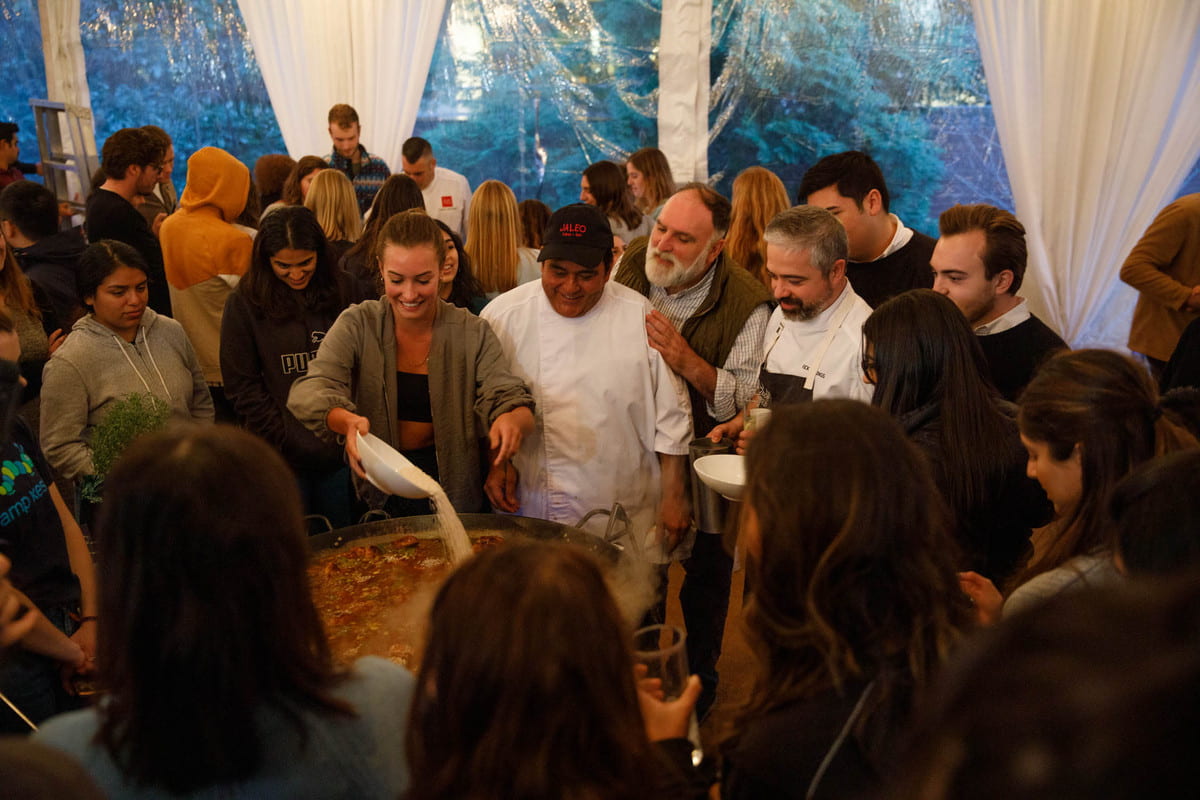
Students in the community engaged course SUST 3003: World on a Plate were treated to an exciting last class when famous chef and activist José Andrés prepared his famous Paella for them all.
The event was featured in the GW Today. “The course examined food history, science and industry, and also incorporated current issues in the global food landscape such as immigration and the undocumented food system as well as national security and food-related health issues.”
Thank you to Dr. Tara Scully for her continued commitment to community-engaged scholarship in this course. Learn more about her work here.