25 Year Anniversary Special Blog Series: Russia’s Investment in Dual Track International Engagement: Sharp Power and Public Diplomacy

Written By: Yelena Osipova-Stocker

Public diplomacy – the process by which international actors communicate their culture, values, and policies to engage foreign publics and accomplish foreign policy goals – has always rested on one essential ingredient: trust. Without trust, no nation can sustain influence, credibility, or meaningful dialogue abroad. Russia’s contemporary approach to global engagement, however, complicates this assumption. While the Kremlin has mastered manipulation and disinformation, it continues to devote major resources to more traditional forms of public diplomacy. Understanding this dual strategy is key to grasping Russia’s global ambitions – a first step before democracies can chart an effective response.

From Cultural Projection to a Dual Strategy

Russia’s modern public diplomacy began in the mid-2000s as an effort to reassert its cultural presence and attract investment after the upheavals of the 1990s. Over time, though, as relations with the West soured and Moscow’s aspirations for global recognition grew, it added a second track: sharp power – the use of manipulation, coercion, and subversion, particularly targeting democratic societies – harkening back to Soviet active measures.

Russia did not abandon its traditional public diplomacy tools. It fused both strategies – combining cultural diplomacy, education, and exchange programs with disinformation and coordinated influence campaigns. This duality reflects a core tension in Russian statecraft: an enduring desire for legitimacy alongside deep mistrust of trust-based international engagement. Under Putin, the Kremlin seeks status and recognition – a seat at the table rather than affection.

The Kremlin’s approach blends short-term and long-term thinking. Sharp power tools – disinformation, deception, and political interference – deliver immediate disruption. Traditional public diplomacy builds the appearance of normalcy and the infrastructure of legitimacy. Together, they reinforce Russia’s image as a major power that cannot be ignored, even as trust erodes.

Beyond the West: Expanding Influence in the Global South

Since at least Peter the Great, Russia has often sought approval and acceptance from the West – a task that has proven elusive. In 2025, Pew Research Center data show that only 13% of Americans view Russia favorably (with 85% viewing it unfavorably), and similar figures hold across Europe, with notable exceptions in Greece (38% favorable), Hungary (32% favorable), and Italy (27% favorable). Yet in countries like Indonesia (64%), India (49%), Nigeria (44%), and Mexico (42%), perceptions are significantly more positive. This divergence underscores Moscow’s success in shifting its focus away from Western approval toward the Global South.

Russia’s narrative of sovereignty, anti-colonialism, and resistance to Western hypocrisy resonates with audiences facing insecurity and economic instability and disillusioned by the unfulfilled promise of democracy. While the United States and Europe have dramatically scaled back public diplomacy investments, Russia – along with other strategic competitors – has filled the growing vacuum with its own programming. The Kremlin’s ultimate objective is not to be liked but to appear as a reliable, even if authoritarian, alternative to Western partners.

Moving to Control the Information Supply Chain

Despite sanctions and economic constraints, Russia continues to fund expansive media and cultural initiatives. In the proposed 2026 budget, $400 million is allocated to international broadcasting operations such as RT and Sputnik. Though banned or restricted in much of the West, these outlets have expanded rapidly across the Middle East, Africa, and Latin America. Where traditional news content might be less effective, RT has pivoted to other ventures like engaging local opinion leaders and bankrolling influencers. In another move, in early 2024, RT launched RT Academy to offer free English-language journalism training and cultivate networks of sympathetic professionals embedded within global media ecosystems.

More significant still is Moscow’s effort to shape the very process of global content production. Russian state-backed outlets have moved beyond distributing news to providing raw material for newsmaking – photos, videos, and information that other media organizations use as inputs. This strategy broadens reach while concealing authorship. A prime example is Ruptly, the RT-owned video agency that, following EU sanctions, moved its operations from Berlin to Abu Dhabi in 2023 and rebranded as Viory. Similarly, Sputnik News, RT’s sister organization, acts as both news outlet and news agency, producing content in 16 languages and newswires in six. By offering this content – often free or at minimal cost – to smaller media organizations, Russia ensures wide republication and citation without overt attribution or Russian branding.

Compounding this issue are content-sharing agreements between Russian state media and foreign outlets – particularly Chinese – which have continued to grow in recent years. Through mutual syndication and co-productions, Russian narratives circulate across a secondary network of media organizations, reappearing under the labels of Latin American, African, or Asian news outlets and local content creators. This cooperation multiplies Russia’s distribution capacity and obscures the provenance of Kremlin-aligned material, allowing it to blend seamlessly into international reporting flows and launder Moscow’s narratives.

Needless to say, the disappearance of U.S. media like Voice of America and Radio Free Asia has created further opportunities for Russia and China to expand the influence of their narratives and grow partnerships with resource-strapped media outlets around the world. The effect is subtle but far-reaching: Russia is no longer merely broadcasting propaganda but embedding itself in the infrastructure of global information production, potentially shaping the very environment in which “truth” is constructed.

Disinformation and the Technological Frontier

Russia’s pursuit of informational influence does not stop with traditional and social media – it has now expanded into the realm of artificial intelligence as well. Research by NewsGuard shows that leading large language models fail far more often when producing content in Russian (55%) and Chinese (51%) than in English or French, largely because their training data in those languages relies heavily on state-controlled or propaganda-driven sources. As a result, users of these languages are disproportionately exposed to distorted or manipulated information.

Even more striking is Russia’s expanding influence in English-language AI outputs. Studies suggest that a vast network of fabricated “news” sites floods the open web with Kremlin-aligned stories, ensuring that these narratives are incorporated into the massive datasets used to train AI systems. As people around the world increasingly turn to LLMs as primary sources of information and interpretation, Russia’s manipulation of that data pipeline gives it growing leverage over how knowledge – whether in Russian or other languages – is framed, repeated, and believed.

Whether the result of deliberate “data poisoning” or simply the exploitation of vast informational gaps, the effect is the same: Russia is embedding its narratives in the very technologies people increasingly trust to explain the world.

The Revival of Traditional Public Diplomacy

Yet, even as Russia manipulates information ecosystems, it continues to invest in more conventional public diplomacy. The “Russia in the World” initiative, launched in 2024, exemplifies this commitment. Designed to promote “spiritual-moral values abroad,” it supports exchanges, research collaborations, and an annual World Youth Festival, which aims to bring tens of thousands of participants to Russia.

In 2026, the Kremlin plans to allocate $147 million to this program – a 120% increase from 2025 – even as other domestic budgets face cuts. This demonstrates that, despite the dominance of sharp power in analytical debates, Moscow still recognizes the enduring importance of traditional public diplomacy as a means of engagement and legitimacy-building. What remains unclear, however, is whether Russia sees trust as a goal or as a vulnerability to be exploited.

For democracies, the task ahead is clear: to rebuild credibility and reassert that genuine engagement – grounded in openness and trust – remains the most powerful form of public diplomacy in a world saturated with manipulation, and to prove that trust and legitimacy can still serve as a source of strategic strength.


25 Year Anniversary Special Blog Series: The Future of Soft Power and Strategic Narratives

Written By: Ben O’Loughlin

…it is a national security imperative for the United States to achieve and maintain unquestioned and unchallenged global technological dominance. (Trump, cited in 2025 US AI Action Plan)

What does that sound like to the rest of the world? What does this line signal about how international communication works in 2025? It is the opening statement of this Action Plan. That plan promises that American AI companies will deliver ‘[a]n industrial revolution, an information revolution, and a renaissance — all at once’; economy, knowledge, culture. But ‘it is ours to seize, not lose’. It is remarkably similar to OpenAI’s mission to become a monopoly and control AI entirely (see Hao, 2025). The narrative: a race the US will win. But in what sense is that strategic? And does it even try to generate soft power to publicly aim to be unquestioned and unchallenged? 

Melissen (2005: 9) writes that ‘most successful public diplomacy initiatives were born out of necessity’. Germany and France invested in national image repair after humiliations in World War II and a need to project a different identity. The US invested after the 11 September 2001 attacks because it had a new story to tell, a global war on terror. Consider the current turmoil in global order, the many wars and conflicts, and – according to the IMF’s former chief economist Gita Gopinath – the immediate threat of global financial crisis far worse than previous crises, this would be a time for keeping cooperation and enhancing mutual support. Soft power should be a technique states are exercising.

We witness changes that put this into question for some but not all. This is not necessarily structural. Some states are projecting antagonistic narratives. And this is where the difference between soft power and strategic narrative becomes important.

To a state, soft power must serve its interests, usually security and economic prosperity. It has been used to boost good relations so that exchange of culture, tourists, science, and students brings economic benefit and makes possible long-term dialogue on harder security matters. This works over generations. It creates good-feeling that is hard to quantify. Finance ministries wonder whether this exists. But most states commit to soft power activities. It sidesteps questions about “power over”. And it means downplaying instances in which your state did not live up to its projected ideal values. But many states commit to this blurry, long-term project. They are not turning away from this.

A change that challenges this is the turn to illiberalism happening in many states – Orban, Milei, Trump and others are not interested in appearing “nice”. David Runciman and Ayse Zarakol explore what it means to live in the age of strongmen: where leadership is individualised and personalised, and power is not plural and dispersed, it is centralised (autocratic); the projection of power and insistence on public conformity to certain values (authoritarian); and by actors willing to overrule institutions and law, and they may say that public good or private favours depend on and come from them (the strongman). This is a pre-modern and monarchical politics; I am the state. The state-society relation is the I-society relation.

This affects soft power and cooperation. Across borders, everything depends on the personal relations our leader can have with other strongmen. This also weakens international institutions and norms. The July 2025 US AI Action Plan has a whole section on diplomacy. That section actually expresses a geopolitical strategy to pressure all non-adversaries to buy US services and not China’s. Most countries, most publics, think the notion of a binary choice nonsensical. They are looking for diplomacy, dialogue, and muddling through. 

Some structural conditions help drive this: social media polarisation, economic uncertainty, but also leaders learning how to seize or manipulate institutions — subvert and staff a supreme court, de-prioritise human rights, restrict free news media. The conditions for a public in country X to have stable perspectives on other countries is more volatile.

This is where strategic narratives come in. Strategic narratives are ‘a means for political actors to construct a shared meaning of the past, present, and future of international politics to shape the behaviour of domestic and international actors’ (here). A narrative is a sequence of events in which actors try to address problems and reach a better ending, for now at least. For Trump, the US was prosperous until it replaced tariff revenue with federal income tax revenue in 1913 (here). This led to a botched century, he said. Today, he will return to that pre-1913 model because he believes in it. This is part of becoming unchallenged and, perhaps, unquestioned. It is a narrative few saw coming. It is not a soft power-friendly narrative. It is not a narrative the rest of the West can make sense of.

China is doing exactly this narrative work. At its recent summit welcoming Russia, India and others, Xi Jinping re-narrated World War II. This war was Russia vs. German Nazism and China vs. Japanese militarism. This indicates the world was always multipolar and that these states helped found the post-45 multilateral order. That narrative recasts what the international system is, with their identity at its core.

This is where it becomes interesting. By analysing the strategic narratives states will advance in the coming decades, we see the lines of contestation and we can unpick exactly how actors use or mobilise points of narrative similarity or difference. Don’t expect simple clear narratives from anyone. When the pressure is on, and you don’t want to be bound to promises you don’t realise, keep narratives ambiguous when needed (see chapter 14 here).

This is a murky, messy, but realistic picture of the future of soft power and strategic narrative. There are many games being played, in many ways. For all these reasons, everything will be questioned and challenged.

 –

Ben O’Loughlin is Professor of International Relations and Director of the New Political Communication Unit at Royal Holloway, University of London. He is co-editor of the journal Media, War & Conflict. He was Specialist Advisor to the UK Parliament Select Committee on Soft Power and Thinker In Residence on ‘Disinformation and Democracy’ at the Royal Academy in Brussels.

Email: ben.oloughlin@rhul.ac.uk

BlueSky: @benoloughlin.bsky.social

25 Year Anniversary Special Blog Series: A Flagrant Act of Cultural Diplomacy

Written By: Mark Taplin

Not so long ago, on a fragrant July evening in Sarajevo, in the courtyard of a 19th century
house-museum, a Spanish musicologist, a Bosnian singer, and a handful of traditional sevdah
musicians committed a flagrant act of cultural diplomacy. Hosted by the Spanish ambassador,
the program linked the centuries-old vocal music of Sarajevo’s Ladino-speaking Sephardic
Jewish population — today reduced to a few dozen elderly city dwellers — to what are today
some of the best-loved folk songs among Bosnian Muslims. As dusk turned to moonlit night,
the one-hundred-some audience of cultural figures and music lovers were invited by the
musicians to join in the singing. Everyone except for the smattering of foreign diplomats knew
the lyrics by heart. It was incontrovertible evidence of how Bosnian Muslim culture was linked,
across some five centuries, to medieval Spain, to Jewish history and to the post-conflict present
of Bosnia-Herzegovina.


How useful to the Government of Spain was that summer Sarajevo gathering? Certainly, there
were some expenses: to finance the stay of a Spanish scholar, to rent the venue, to publicize
the event, to pay the musicians. Did the evening in any measurable manner advance Spain’s
immediate foreign policy agenda? Unlikely. Yet the Spanish government, along with its
ambassador, apparently felt the effort was worthwhile. Were there really benefits to be had
from an historical riddle, wrapped in a musical evening, inside a contemporary bilateral
relationship?


Over nearly four decades in the U.S. Foreign Service, I concluded that cultural diplomacy, along
with educational exchanges and information programs, were as vital to successful statecraft as
the other elements of national power, hard or soft. Armies and advanced technologies are
important, but so too are a country’s capacity for finding common ground internationally and
making itself attractive to others. Public diplomacy offers some of the best engagement tools of
all.


Let’s face it. It is a rare formal demarche that anyone, sender or recipient, might recall years
later. High-level official visits, with few exceptions, disappear quickly into the memory hole of
today’s frenetic global news cycle. A lot of the good work performed by diplomats, in fact, never
sees the light of day.


On the other hand, lots of people recall vividly, even decades later, their involvement in one or
another cultural diplomacy initiative. It might be an orchestral performance, an art exhibition, a
jam session, a film director’s talk, a hip-hop workshop. These types of in-person experiences,
bridging cultural boundaries, truly register. They connect to individuals in a direct way and,
repeated, at scale and over time, can even help shape how societies view one another.
To take an example from my own time in diplomacy, I doubt whether anyone who attended the
acclaimed pianist Vladimir Horowitz’s 1986 recital in Moscow — he was performing in his native
Russia for the first time in over half a century — has forgotten it. The Russian-American maestro’s appearance was a powerful signal from the two superpowers that they intended to
lessen tensions and promote understanding. It was one of countless public diplomacy
initiatives, both large and small, that helped build a measure of trust and confidence between
the West and the Soviet bloc during the Cold War. Undoubtedly, it helped bring that
superpower confrontation to a happier conclusion than many had anticipated.

Typically, policymakers and appropriators shrug their shoulders about investing in U.S. cultural
diplomacy efforts. Their attitude might be conveyed in just two words: “Why bother?” Often,
they frown at the cost of sending living, breathing performers and cultural figures abroad —
leaning instead towards the pennywise strategies of launching tweets across borders or
spamming the world with the utterings of senior officials. American popular culture permeates
the globe, they argue, so why not simply allow the private sector to keep on keeping on? They
find frustrating the inability of, say, a ballet performance to increase support in realtime for their
latest policy initiative. Even George Kennan, probably the most intellectually sophisticated of all
20th century American diplomats, preferred to keep cultural diplomacy at arms’ length — best
dealt with well outside the sober halls of the State Department so as not to interfere with the
“serious” work behind closed doors.


But is it possible that cultural diplomacy, like the slow-food movement, requires patience but in
the end results in something more wholesome — emotionally and intellectually — than the fast
food ethos of today’s hostile X bouts and flash-fry TikTok vids? Research has shown a striking
shift in the orientation of Millennials and Gen Z, away from the materialism of their parents
towards valuing direct experiences like travel, learning and personal engagement in shared
causes. Does that open the door to new forms of cultural diplomacy that would emphasize
collaboration and openness across borders rather than the thin-skinned nationalism and
chauvinism that of late has been ascendant in so many places? On the global stage, mutual
respect and understanding is a better recipe for winning hearts and minds than ridicule and
bullying.


For countries intent on building trust and a positive reputation, another factor may argue for
greater reliance in the years ahead on cultural diplomacy and people-to-people exchanges. It
seems plausible that the value of in-person exchanges and cultural diplomacy will increase
relative to other forms of public diplomacy, especially as the credibility of news and information
sources are increasingly undermined by opaque algorithms and aggressive propaganda. AI
hallucinations and outright forgeries — some of which are much more consequential than fake
videos of Tom Cruise and Taylor Swift — appear to be just the tip of tomorrow’s hulking iceberg
of falsity. When seeing is no longer believing, can “experiential” cultural and educational
programs — a form of “doing is believing” — provide an antidote?
As I write these words, I cannot recall for the life of me the last Truth Social post I read, just this
morning. But I do remember an evening not so long ago in Sarajevo, when I discovered that a
Bosnian sevdah classic, “When I Went to Bentbasa,” is based on an old Spanish Sephardic
melody, “Mi Kerido, Mi Amado,” that in turn is a Hebrew prayer song still sung in synagogues
today. It was a lesson in cross-border connectedness that any embassy or government could
feel proud of.

25 Year Anniversary Special Blog Series: Looking Ahead to the Future of Cultural Diplomacy

Written By: Robert Ogburn

Note: The opinions and characterizations in this piece are those of the author and do not necessarily represent those of the U.S. government.

Next month, the George Washington University’s Institute for Public Diplomacy and Global Communication (IPDGC) will mark its 25th anniversary with a two-day conference on November 6–7. Over the past quarter century, the Institute has been a hub connecting scholars, practitioners, and policymakers to explore how nations communicate their values in a volatile, interconnected world. It’s fitting that this celebration takes place in Washington, D.C.—a city that lives and breathes global communication every day.

On November 7, I’ll join a panel on the future of cultural diplomacy. While colleagues will discuss the role of Washington agencies and institutions, my perspective centers on practitioners in the field—the Public Affairs Officers (PAOs) who engage daily with local communities abroad. They are the on-the-ground architects of cultural diplomacy, constantly navigating complex social, political, and digital environments to build mutual understanding.

Having served as or in support of PAOs in Washington, D.C. and at U.S. missions in Seoul, Cairo, Baghdad and Ho Chi Minh City, I’ve seen firsthand how success in cultural diplomacy depends on context and creativity. The strongest programs grow from genuine collaboration with local partners. Each post brings different challenges—limited resources, shifting priorities, new technologies—but also moments of profound connection where relationships, not rhetoric, become diplomacy’s true medium.

In Vietnam, American programs supported through the U.S. Ambassadors Fund for Cultural Preservation are restoring architectural treasures in Hue and Hoi An, while educational partnerships have expanded English training and STEM exchanges. cultural diplomacy is now central to the country’s international identity. And Battery Dance Company brought some of the first postwar modern dance engagements to the country. Cultural diplomacy by the Vietnamese government is now central to the country’s international identity. Vietnam MFA’s annual Days Abroad festival builds bridges worldwide—recent editions in Paris, Tokyo, and Seoul showcased Vietnamese fashion, film, and cuisine. Efforts like these, combined with non-governmental initiatives such as PeaceTrees Vietnam, which has some USG funding, use culture to transform wartime history into shared environmental and humanitarian projects that bring communities together.

In Korea, cultural diplomacy is evolving alongside an unstoppable pop culture wave. Collaborations between U.S. embassies and Korean institutions—such as hip-hop diplomacy workshops in Seoul, youth exchange programs, and the Arts Envoy series connecting K-pop producers with American musicians—illustrate a dynamic partnership rooted in creativity. Beyond entertainment, such programs reveal how shared artistic and social expression can create lasting trust and redefine America’s image through partnership rather than projection.

Egypt tells another story of longevity and reinvention. Its cultural power lies in preserving identity amid change. Through initiatives like the English Access Microscholarship Program, joint museum projects with the Smithsonian, and the U.S.-Egypt Cultural Heritage Preservation Partnership, the focus has been on youth, archaeology, and community exchanges. Egypt’s lively art spaces—like Zamalek’s independent galleries and Cairo’s music festivals—embody cultural diplomacy as dialogue, not doctrine. Here, public diplomacy officers and Egyptian cultural leaders collaborate to build platforms that amplify local voices and celebrate shared heritage.

Beyond the bilateral, cultural diplomacy’s reach is expanding through global initiatives that blend art, sport, and music. Here are some examples from the USG…the Sports Envoy Program have sent American athletes—Olympians, coaches, and players—to over 60 countries each year to promote teamwork, women’s entrepreneurial empowerment, and not forgetting the most needy. Arts Envoys—including visual artists, actors, and poets—conduct workshops and build creative communities across continents. Meanwhile, American Music Abroad and Next Level, which pairs hip-hop artists and dancers with local performers, have proven that even beats and lyrics can spark dialogue faster than speeches ever could. These programs exemplify cultural diplomacy’s profound strength: people engaging people through shared passions.

Such examples highlight a consistent lesson. Whether restoring monuments in Vietnam, collaborating with K-pop creators in Seoul, or co-creating art installations in Cairo, the enduring power of cultural diplomacy lies in respect and reciprocity. It succeeds when it listens and adapts, when it emphasizes partnership over persuasion.

Looking ahead, the next 25 years of cultural diplomacy will depend on how institutions and practitioners respond to global change. Washington policymakers must keep supporting these practitioners—the ones bridging the “last three feet” with creativity and local insight. That means addressing administrative barriers, investing in flexible programs, and empowering embassies to shape initiatives that reflect their communities’ realities. Cultural diplomacy succeeds when Washington trusts the field to lead and innovate.

We also need new frameworks that combine traditional exchange with digital engagement. Virtual tools cannot replace human connection, but they can extend it. Hybrid programs, like online artist residencies and e-sports diplomacy exchanges, will shape the next generation of engagement, making global participation more inclusive.

As IPDGC marks its quarter century, its legacy is a reminder that the conversation about cultural diplomacy is always evolving. For those of us who’ve practiced it in the field, the future feels less like an abstract policy challenge and more like a continuation of the work already being done—in art studios and classrooms, at community centers and concert halls, in every handshake and shared story across borders.

The task ahead is to ensure that this work continues, grows, and inspires the next generation. Because the future of cultural diplomacy depends on people—the practitioners who listen, the artists who exchange, and the citizens who connect.

Here’s to IPDGC’s next chapter—and to the human links that keep diplomacy real.

25 Year Anniversary Special Blog Series: The High Ground of Soft Power

Written By: Rick Ruth

We come on the ship they call The Mayflower,

We come on the ship that sailed the moon,

We come in the ages most uncertain hours

And sing an American tune…

— Paul Simon

When President Franklin Roosevelt passed away in April of 1945, having guided the nation through economic recovery and then war on two fronts, he was in the process of writing a speech that looked to the future–a speech he was never able to give but into which he poured his distilled experience.

In the draft he wrote: “Today we are faced with the preeminent fact that, if civilization is to survive, we must cultivate the science of human relationships—the ability of all peoples, of all kinds, to live together and work together, in the same world, at peace.”

A decade later, another President shaped by the triumphs and horrors of a world war, Dwight Eisenhower, convened a remarkable conference to establish a program of global people-to-people exchanges. Participants represented a broad cross-section of American society, from the Director of the Philadelphia Symphony Orchestra to the President of the AFL-CIO, from the presidents of the Studebaker Corporation and CBS to the head of the National Council of Churches and the New York Boxing Commissioner.

Eisenhower told the assembled that “the purpose of this meeting is the most worthwhile purpose there is in the world today: to help build the road…to an enduring peace.”

He told them that there would never be enough diplomats or government officials to get the job done, that it was a task to which he summoned the American people.

The purpose set out by both Presidents Roosevelt and Eisenhower is still the most worthwhile purpose in the world. We are still working to build that road.  And, as in the past, the conflicts we face in this process are not only of arms but of values and beliefs. 

But the U.S. Government has still to fully adopt and incorporate the vision of Roosevelt and Eisenhower into its strategic planning for soft power. While the tactics of hard power and soft power may be different, the need for strategic planning is the same.  In an ever-evolving contest of values, the U.S. must begin to adopt soft power strategies that borrow from key concepts of military strategy. 

It is axiomatic that any military leader, from Hannibal to Patton, considering a contest of arms, will survey the terrain on which the clash will take place, seeking out the natural advantages and identifying the obstacles.  Both armies at Gettysburg understood the importance of the high ground on Cemetery Ridge.  On D-Day, Allied and Axis armies alike focused on the forbidding heights of Pointe du Hoc.  So critical, in fact, is the role of the landscape, that it has often been said by military strategists that “topography is fate.” 

There are natural advantages and features in the soft power landscape just as there are in physical topography, although we are not accustomed to thinking of them in this way.  Leveraging these soft power assets–this soft power high ground, if you will–is as crucial to success in public diplomacy as it is in armed combat.

The good news for the United States is that it is uniquely equipped with soft power assets, with the capability to wage peace.  Even a cursory look at the world around us reveals that the US already occupies much of the high ground in any contest of values.  For example:

  • Democratic values that stress personal freedom, liberty of conscience, and the worth of every individual;
  • The world’s highest quality, most open, and most diverse system of higher education;
  • The world’s most widespread and influential popular culture;
  • A robust entrepreneurial culture with leadership in technology, research, and science.
  • A vibrant multicultural population united by common citizenship and values;
  • And last, but far from least, the English language—the lingua franca of today’s world.

It is important to note, moreover, that these assets are largely unique to the United States.  There is no crush of international students at the gates of Iranian universities.  There is no global thirst to learn Chinese. There is no Russian Taylor Swift or Beyonce.  One cannot imagine Elon Musk emigrating to Russia or China.

It is equally important to note that “soft power” funding, relative to other aspects of national security, is a bargain. It is the most cost-effective strategy over time since nothing need be built from scratch–the investment in all these sectors, from music to space exploration—already exists and their “American” reputation already precedes them around the world.

Our world-class system of higher education excels.  Our creative economy thrives.  Our values have endured from 1776 to this day.  We need not re-invent the wheel and we need not underwrite the cost of inventing the wheel.

There is, necessarily, an important role for government to play.  Terrain can be a force multiplier, in soft power as well as hard, but these assets do not, individually or severally, constitute a coherent strategy.  They do not, in and of themselves, guarantee that we reach and engage key audiences with the right message at the right moment.

Therefore, just as the military would take advantage of natural strengths, occupy high ground, reinforce key assets, so the USG needs to reinforce and maximize our existing assets in soft power through enhanced staffing and funding. 

I believe that when the current AI techno-panic begins to recede–as I believe it will–we will find that the most precious commodity in the world is not a rare earth mineral buried deep underground, but rather human authenticity.

25 Year Anniversary Special Blog Series: The Future of Public Diplomacy

Blog #1

Bruce Gregory

Twenty-five years ago, a small group of visionary George Washington University (GWU) scholars and Public Diplomacy Council (PDC) members established the Public Diplomacy Institute (PDI), later renamed the Institute for Public Diplomacy and Global Communication (IPDGC).

The Institute was launched in July 2000, pursuant to a Memorandum of Understanding signed by leaders of GWU’s School of Media and Public Affairs and the PDC, a non-profit organization committed to the study, advocacy, and practice of public diplomacy. A combined board was formed with representatives from the signatory organizations and the Elliott School of International Affairs. GWU Professor Steve Livingston was elected board chair. The PDC’s Barry Fulton, a recently retired US Foreign Service officer, was the Institute’s first director.

The Institute’s scholars and practitioners worked together in pursuit of two primary goals: (1) To advance the academic study and professional practice of public diplomacy through teaching, research, scholarship, publications, academic conferences, and public forums, and (2) To provide expertise on cutting edge issues in public diplomacy and collaborate with scholars, the media, diplomacy and communications practitioners, and government and civil society organizations in the US and abroad.

It was ten years after the Cold War and one year after the US Information Agency had been abolished. The Institute’s pioneers honored past achievements in twentieth century public diplomacy, but their focus was on the future.

That future quickly brought the terrorist attacks of 9/11, wars in Iraq and Afghanistan, new digital technologies, the rise of social media, many more diplomatic actors in governments and societies, and an expanding array of transborder threats with no agreed definitions, solutions, and visible endpoints.  

The PDI initiated a variety of activities most of which continue today. Its members taught academic courses, mentored US and international students, hosted public forums and academic roundtables, contributed to public diplomacy reports, developed courses for foreign diplomats, published books, sponsored visiting scholars and State Department PD Fellows, advised lawmakers and Congressional staffs, established its Walter R. Roberts Endowment, and initiated its annual Walter Roberts lectures.

The years brought leadership changes. PDC Council presidents McKinney Russell and Bob Coonrod represented the PDC on the Institute’s board. Successor Institute directors included Bruce Gregory, Mark Taplin, Sean Aday, Janet Steele, Will Youmans, and Babak Bahador, all of whom are participating in IPDGC’s 25th anniversary conference.

Key decisions in 2008 led to structural changes. The PDI was given a new charter, a new name, and an operating budget. Henceforth, a GWU faculty member would direct the Institute and a new MA program in Global Communication. The PDC, later renamed the Public Diplomacy Council of America (PDCA), maintained informal ties with the Institute but broadened its relations with other universities and non-profit groups.

The IPDGC’s mission and core functions continued unchanged. With the strong support of GWU’s faculty, visiting scholars, public diplomacy fellows, engaged students, and Roberts Endowment, IPDGC became a leading voice in discourse in the US and abroad on political communication across borders and diplomacy’s public dimension.

Today, IPDGC still looks to the future. But it does so in circumstances dramatically different from when it was founded.

Some countries, including the United States, are systematically dismantling diplomacy’s institutions, defunding its activities, and subverting its career services, while others such as China are building diplomatic capacity.  Populism and illiberalism are ascendant. Digitalization and A.I. technologies, changing faster than strategies and operational decisions, are creating opportunities, disruptions, and a crisis in knowing what is true and real. Profoundly complex geopolitical conflicts and global problems continue to elude cross-border solutions.

Among IPDGC’s comparative advantages going forward, three stand out.

First, located in a major research university, IPDGC is a magnet not only for students seeking degrees, but for scholars engaged in research and practitioners who understand the value of professional education. No practitioner can have deep knowledge of all of today’s complex issues, technologies and policy domains. This gap between operationally relevant knowledge and diplomatic capacity incentivizes the need for career-long learning opportunities away from the pressures of daily activities. Practitioners gain from exposure to applied knowledge categories, diverse analytical perspectives, new technologies, critical and innovative thinking, and trends in operational environments. The fundamental goal of professional education is not to learn diplomatic tradecraft but to learn about what’s around diplomacy.

Second, IPDGC’s work is a blend of academic research, degree programs, practitioner-oriented courses, and public events. It is a community that understands the distinction between education and training, the essential importance of academic freedom, and that scholars and practitioners have different methods, priorities, and norms. At the same time, IPDGC recognizes that research on diplomatic practices can illuminate conceptual issues in theory building, just as academic study has value for practitioners seeking to change institutions and patterns of practice. Signature achievements include its MA program, foreign ambassador speaker series, and the talented US Foreign Service officers assigned to teach, learn, and engage with IPDGC’s faculty and students during the past 20 years. In July 2025, the State Department imprudently ended its Diplomat in Residence Program and terminated university assignments of career diplomats. In 2005, State had stated “that it is in the best interests of the Department to place a senior PD officer on assignment to PDI.”

Third, IPDGC and academic institutes elsewhere, perhaps not without some risk, are positioned to provide much needed expertise and civil discussion on polarizing issues in diplomatic practice, mediated discourse, and exigent controversies now challenging liberal democracies. IPDGC also is well suited to lead in a multidisciplinary research agenda that is extending the academic study of an increasingly “societized” diplomacy beyond international relations and communication studies to academic fields across the social sciences and humanities.

At IPDGC’s 25th anniversary conference scholars and practitioners will celebrate what has been achieved. Importantly they will engage in conversations about ideas and actions that will strengthen future study and practice. To be celebrated when IPDGC convenes its 50th anniversary in 2050.

Bruce Gregory is an affiliate scholar at George Washington University’s Institute for Public Diplomacy and Global Communication. 

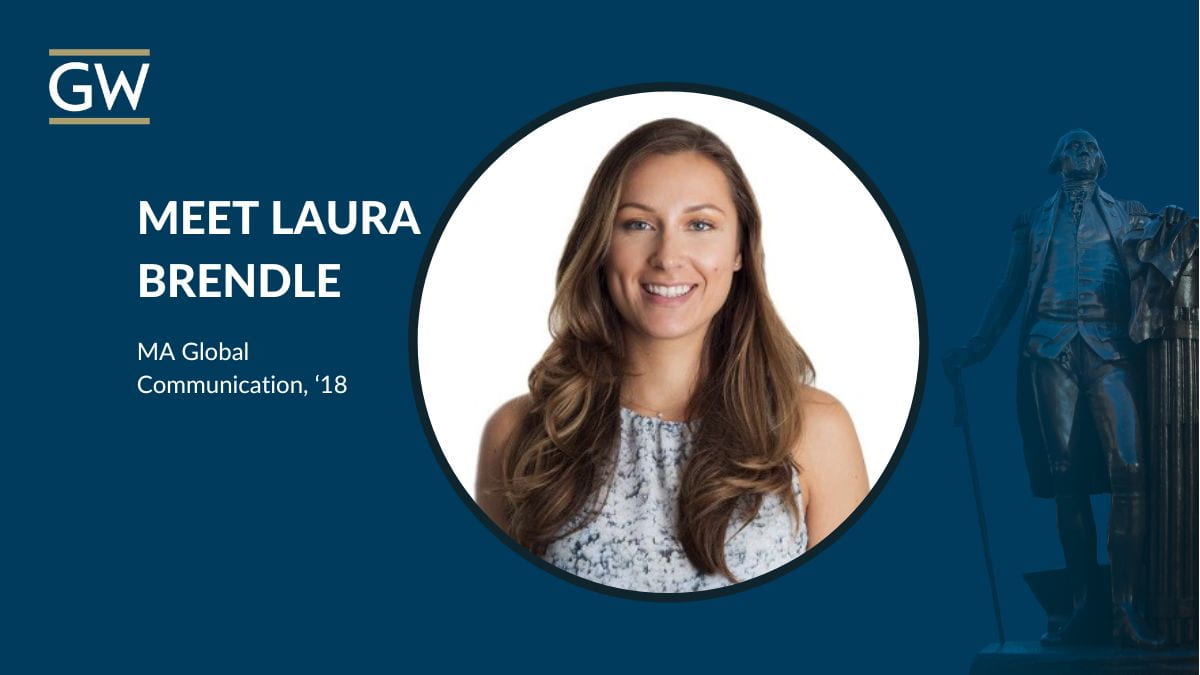
Alumni Spotlight: Laura Brendle

By Alexis Posel, IPDGC Communications Student Assistant

Laura Brendle graduated from the M.A.Global Communication graduate program in 2018. She was the recipient of that year’s Student Public Diplomacy Award which recognized her efforts in public diplomacy studies.

She currently works at Webrepublic, a digital advertising agency in Switzerland, where Laura is originally from. Her academic journey in the Global Communications program has taken her into the world of international marketing.

Tell me about how you chose to come to GW for the MA program in Global Communications. And what are you doing after your graduation?

I began my program at GW in 2016. It was a very interesting year, politically. You can’t hear it from my voice, but I’m actually Swiss, not American.

I had been in the UK and working in the film industry over there at the time, watching the US election happen. I always had this interest in global politics, and also in the politics of the U.S. So, that’s how I chose to come to GW for my master’s degree in Global Communication. I think that kind of sets the scene for my kind of non-traditional pathway in both directions.

After graduation, I began working in the digital advertising industry. I got into that (job) because I of a class I had taken at the School of Media and Public Affairs. And this was where I met my future boss – they had been a guest lecturer in one of the classes. So, I worked for the digital agency Targeted Victory for a year after graduating.

Later, I returned to Switzerland, where I began working at another digital advertising agency, Webrepublic – no longer focused on politics, (but) on all aspects of advertising.

While I’m not the traditional candidate to be talking about why the Global Communication program as I think a lot of people may not want to go on the path that I’ve gone, I think this MA program has definitely helped me in my current industry: learning from people with different experiences and analyzing the way that people think – especially in the political communication aspect – knowing how to influence or how the media influences, are all things that are beneficial to know.

Looking back on your time at GW, which classes do you think have helped you figure out what you wanted to do?

What I think I have gained overall from the Global Communication program is communication (skills). Getting your point across succinctly, using these skills of persuasion, and understanding the person that you’re speaking to. Those are kind of the strategies that I still employ in advertising.

The class on Strategic Politics left an impression on me about using humor strategically. It was a really interesting class combining comedy and politics – learning how to use humor in communication to get your point across. It was something so different that could connect all my interests as I was working on the comedy side of things while working in the film industry.

As I mentioned, in joining Targeted Victory, I was a Republican public communications, PR and advertising firm. I went into that because GW can be a very liberal bubble for a European person, not understanding the perspective of why Trump happened. So, I was curious to get into a space with Republicans and figure out what happened there. That was my motivation, but then I fell in love with advertising through working there.

Another experience I want to mention is the Capstone project at the Elliot School of International Affairs. My group brought together different knowledge and skills – one person was focused on trafficking issues, and another was focused on international women’s policies. I brought in the global communication aspect. We traveled to South Korea and interviewed North Korean refugees, in particular, refugees who had been trafficked across the border with China.

I love that the Global Communication program could give all these different touch points with all these different people from different areas of expertise and help translate things into a community communications perspective.

Global Comm grad student receives I/We award

Congratulations to Global Comm graduate student Rehana Paul for being a recipient of this year’s International Women of Elliott Awards!

The International Women of Elliott (I/WE) Student Awards, established by the International Women of Elliott Executive Circle, provides recipients with financial support for various programs, activities, and needs related to their academic program (including conference and tuition fees and unpaid internships) if they have demonstrated commitment to advancing women’s roles in international affairs worldwide.

As a recipient of the International Women of Elliott Award, I am empowered to continue studying the role of women in countering violent extremism, as well as the impact of CVE/CT campaigns on marginalized women. This award will allow me to fully devote myself to pursuing my MA in Global Communications, as well as working on the International Religious Freedom Reports at the State Department. I am honored to join a community devoted to promoting women’s leadership, and look forward to learning from the strong women who compose it.

-Rehana Paul

Alumni Spotlight: Saiansha Panangipalli

By Mohamad Fayaz Yourish

Saiansha Panangipalli is a former Global Initiatives Fellow at GW who graduated from the M.A.Global Communication graduate program in 2021.

She currently works as the Programs and Communications Lead at the Science Innovation and Technology Network at the British High Commission in India. Previously, she worked as a communication and project management intern at the Embassy of the Kingdom of Morocco in India, a Media and Public Affairs Intern at the Pan American Health Organization (PAHO), and as a Communication Intern and Volunteer at the Embassy of India in Washington, D.C. 


In this PDx podcast with GW Graduate Fellow Fayaz Yourish, Saiansha reflects on her time at GW and how the experience helped her thrive professionally. She underscores the skills and experiences acquired in and outside the classroom at GW and provides valuable advice to prospective students interested in the M.A. in Global Communications program at GW.

Learn more about Saiansha’s diverse experiences and how she inspires the next generation at GW.

A Conversation with Christopher Teal

Last year we introduced Christopher Teal, the Institute’s Public Diplomacy Fellow for 2022-2024. As a GW alumnus, he has enjoyed his time back on campus and now being on the “other side of the academic fence”, teaching an undergraduate course in public diplomacy. In this video interview with GW Graduate Fellow Mohamad Fayaz Yourish, Chris talks about how he integrates his practical insights from the diplomacy field into his classes.

In his long diplomatic career, Chris has been the director of the State Department’s Career Development and Assignments Mid-Level Division. His extensive overseas assignments include serving as Consul General in Nogales, Mexico, and various public affairs positions in countries like Sri Lanka, Mexico, Peru, and the Dominican Republic.

He is also an author and filmmaker – More about the IPDGC Public Diplomacy Fellow 2022-2024