Tina Donnelly, MPS, is an Assistant Managing Editor at Penguin Random House, where she assists department heads with all aspects of audiobook production and record keeping, as well as supports the Managing Editorial team on audio and large print projects and metadata maintenance. She is a talented 2022 graduate of the MPS in Publishing program at George Washington University, and the program’s newest instructional assistant. In the latest in our series of alumni profiles, Tina shares her experiences in the GW Publishing program, her work on DEIA issues, and her work at PRH.

Your current role is Assistant Managing Editor at Penguin Random House, where you work with audiobook and other products. Can you tell us about your work at PRH? What are some aspects you learned in the MPS in Publishing program have been helpful in your work?
As Assistant Managing Editor, I handle a variety of tasks within the audio department. While my main responsibility is maintaining the metadata of our thousands of audiobooks published each year, I also manage things such as web copy edits/updates, Canadian pricing conversions, and ONIX feeds, as well as proofing and reporting on titles in our Random House Large Print imprint, which is also handled by Audio. I enjoy my job immensely not only because I love books and audiobooks, but also because I get to work in so many different parts of the production and post-production process: all of which helps get our books into the hands of readers around the world.
Most everything I learned in the MPS in Publishing Program has been helpful in some way at improving my performance at Penguin Random House. One thing is simply a more thorough understanding of the publishing industry, and how a book goes from an author’s head to the hands of readers. A more solid knowledge of this process, not to mention the business behind it, went a long way in helping me understand just why we do the things we do at PRH. Additionally, the lessons on understanding brand image and audience interaction were essential at improving some of the more marketing-focused responsibilities at my job, such as celebrity narrator announcements and cover reveals.
…Getting to interact with the professors, all of whom are experts in their field and talented beyond measure… made understanding the real-world application of the material so much easier. Additionally, the professors’ stories and examples of working in publishing helped me to prepare for navigating the field.
What was the most challenging aspect of the MPS in Publishing program? What was the most rewarding?
The most challenging aspect of the publishing program was learning about areas of the industry that were not initially as interesting to me. As a reader and a lover of books, I was much more interested in the courses that focused on acquisition, copyright law, editing, and audience interaction. The more technical courses, ones that focused on coding, software, and technologies, were a bit more difficult for me. Thankfully, I had some truly gifted teachers that helped me along in areas that I struggled with, so it was more challenging than undoable, and I got exposure to a side of publishing that I otherwise would not have experienced.
The most rewarding part of the program was getting to interact with the professors, all of whom are experts in their field and talented beyond measure. The ability to learn lessons through the professors’ experiences in the field made understanding the real-world application of the material so much easier. Additionally, the professors’ stories and examples of working in publishing helped me to prepare for navigating the field.
What are some of the reasons you decided to pursue the MPS in Publishing degree? Why did you choose GW specifically?
I wanted to pursue a degree in publishing not only as an advantageous career move, but also because I have a genuine passion and interest in the field. As an avid reader, I have always wanted to work in publishing, and so I pursued a degree in the field. I firmly believe a degree in publishing will go a long way in securing one a position for an already highly sought-after job, not to mention that it will help tremendously with upward movement within the industry.
I chose George Washington University’s publishing program for several reasons, namely that their program simply looked the best. The curriculum was stacked with relevant and interesting-sounding courses, the instructors were all industry professionals, and best of all, the program was designed for “working adults,” which is what I was when applying. Plus, the program is at the George Washington University, a prestigious institution, and an affordable one at that.
Lastly, the staff and faculty while I was inquiring about the program were beyond helpful and informative; they were so patient and thoughtful in answering my many questions, phone calls, and emails. It was a level of care I had not received at other graduate programs, and it was something that really drew me to GW.
A highlight for us last year was having you present at our 12th GW Ethics in Publishing Conference—where you moderated the plenary with Kimberly Ayers Shariff, Executive Vice President, Strategy for Diversity Equity & Inclusion, Penguin Random House, and also presented your own capstone Ethics in Publishing project in a separate session! Can you tell us about the genesis and trajectory of your project, why you presented at the conference, and about your conference experience?
I took Randy Townsend’s Ethics in Publishing course in the Fall of my second year in the program. I wasn’t expecting to like it as much as I did; I thought it was an important and relevant class to take, but I didn’t realize how much I would gain or learn from it. I was really intrigued and impressed. One thing that stuck out to me was just how little diversity there was in publishing. I had a basic understanding that it was not as diverse as it could be, but I was a little surprised to find out just how overwhelmingly uniform the industry was. This homogeneity is reflected in both the publishing workforce and product output. This bothered me because as a big reader, I have always been able to see myself reflected in various stories, circumstances, and characters, and it saddened me that this was not the case for all readers. Or rather, that their portrayals in literature seemed limited, while mine seemed endless.
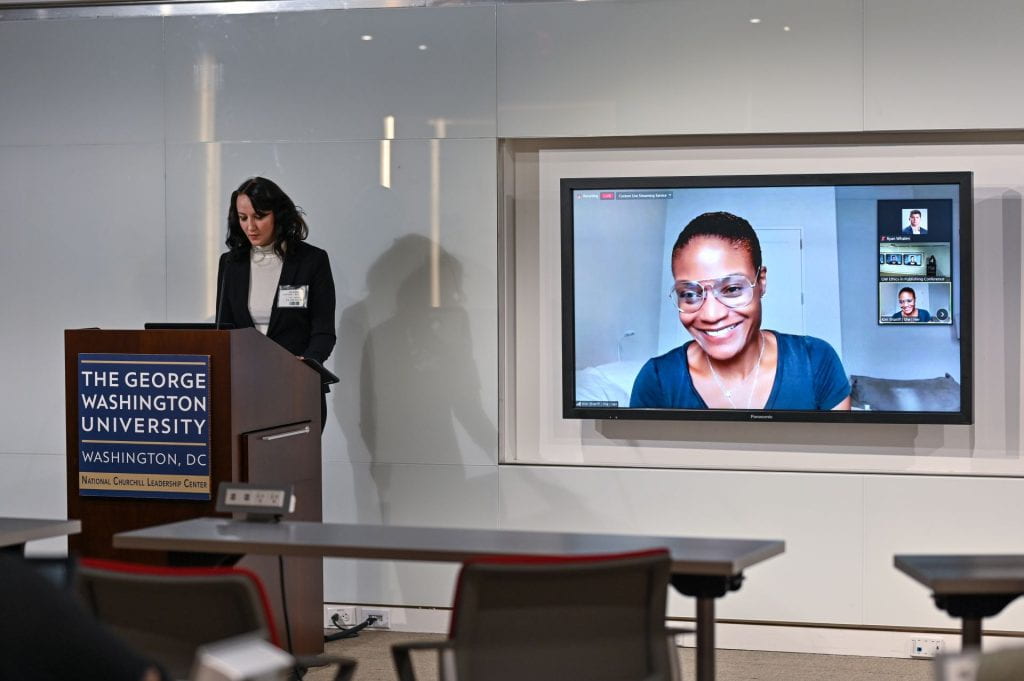
I was so drawn to this issue that I wanted to make it my capstone project for the course. Thus, I set out to make a case for why and how the industry can be more diverse, as well as a snapshot at its current demographics. The latter was the easy part; my own company, PRH, had just released their yearly diversity and inclusion report, and statistics for other companies were not difficult to find since this is an oft-discussed topic. The hard part came when I had to formulate my own ideas and suggestions for how to rectify the problem and move forward to a more diverse and representative publishing landscape. This is where Kim Shariff came in. Kim is the Executive Vice President, Strategy for Diversity Equity & Inclusion at PRH, and I had several conversations with her over what should be done, what is being done, and what further we can do to address this problem. Kim Shariff is an outstanding and insightful intellectual, as well as an experienced Diversity and Inclusion Officer, and she was able to give me some helpful ideas, tools, and attitudes towards tackling this issue. It is because of her guidance and advice that the presentation turned out so well, and I was proud to have her consult on it.
I wanted to present my findings at the Ethics in Publishing Conference namely because I am very passionate about this subject; it is close to my heart as a lifelong booklover who wants everyone to be able to indulge in the joys of reading. Additionally, Randy Townsend and John Warren both gave me some solid feedback on my initial capstone project, and I wanted to incorporate their suggestions to make it even stronger and more informative—more of a call-to-action, instead of mainly a passion project. I am happy to report that not only did I have the privilege of presenting my findings at the conference, but I also had the pleasure to moderate the plenary session with Kim Shariff, as well as get to see some other incredibly interesting and thought-provoking presentations from other GW alumni.
What advice would you give to new or prospective students to the MPS in Publishing program?
The most important advice, in my opinion, is to study as broadly as you can and take classes outside of your normal interests. People move around in publishing a lot, and you never know what areas of study will come in handy later in one’s career. Also, another big piece of advice that seems basic but cannot be over-emphasized is to attend the online sessions. These are not technically required, but students will learn and gain so much more from the course if they attend the weekly online sessions. This is an opportunity to engage with other students, ask questions, clarify details of the week’s lesson and assignment, and bounce ideas of your classmates; one really goes so much farther if they can attend.
I chose GW’s publishing for several reasons, namely that their program simply looked the best. The curriculum was stacked with relevant and interesting-sounding courses, the instructors were all industry professionals, and best of all, the program was designed for “working adults,” which is what I was when applying. Plus, the program is at the George Washington University, a prestigious institution, and an affordable one at that.
What courses or professors had an impact on you during your time at GW?
Publishing Entrepreneurship with John Warren is exceedingly helpful for young publishing professionals. Even if you don’t plan to be an entrepreneur yourself, this course is great for understanding the basics of the business.
Copyright Law/Print & Cyberspace is an essential class for anyone who wants to work in publishing, no matter what area. Understanding the basic rules of copyright, trademark, and fair use is critical in any media field, and this course excellently teaches these concepts.
The Professional Editor is another course that anyone entering the publishing world should take. Even if one is not necessarily going into this department, this is an important course that covers not just editing, but also managing, proofing, team relations, and author interaction. If anyone wants to work with books or journals at all, this class is a must.
Production Management is a challenging course, but it goes without saying that this is a necessary course for anyone entering publishing. Having a basic understanding of the production process, even if one has nothing to do with the production side of things, is critical for understanding a book’s life cycle. Knowing this is vital because no matter what area of publishing one is in, production will affect them in one way or another, and it is best that one has a working knowledge of the process.
John Warren had a huge positive impact on my time at GW, not just as a professor but also as the program director. He was exceedingly helpful whenever I struggled and assisted me in navigating the program whenever I was uncertain how to proceed.
Dean Smith was also a major ally in my time at GW. As one of the first professors I had in the program, he helped prepare me for the rest of my education and gave me the confidence I needed to tackle my course load.
Both Josephine Sciortino and Rebecca Brenner were each such massive supports through their class, The Professional Editor. They each had so much wisdom and experience they shared in the course, not just about editing but also about how to successfully operate in all areas of publishing, as well as how to act as a true professional in the workplace. Their guidance and encouragement had such a positive impact on me in my last year of the program.
Greg Britton is another professor who is almost too good to be true. He is not only one of the kindest people I have ever met, but he is also an extraordinary talented professor and masterfully teaches his class on book acquisitions. His eagerness to connect with students and teach the material in a more interactive and collaborative fashion made such a difference in helping me to understand acquisitions more thoroughly, not to mention it made me much more interested in the topic.
The value of GW’s MPS in Publishing degree can truly not be overstated. The degree will not only bolster you as a candidate for publishing jobs, but it will also instill you with a sense of ease and confidence in navigating the field; one has, after all, mastered it. Personally, I have newfound respect (and responsibilities) at my own workplace because my team feels I can handle more, and they are correct.
What have you found to be the value of the MPS in Publishing degree, and how are you using what you learned, as a rising publishing professional?
It is unarguable that the value of GW’s MPS in Publishing degree can truly not be overstated. The degree will not only bolster you as a candidate for publishing jobs, but it will also instill you with a sense of ease and confidence in navigating the field; one has, after all, mastered it. Personally, I have newfound respect (and responsibilities) at my own workplace because my team feels I can handle more, and they are correct. I feel surer in myself as an employee and my own capabilities. The degree itself does a lot to impress one’s superiors too; just having it shows not only that you have a strong sense of how the business operates, but also that you cared enough to pursue higher education for your career, both of which go a long way in highlighting you as a dedicated professional.
Can you provide any other tips that might be helpful for prospective students?
Take as many electives as you can manage, and try to study things that are outside your comfort zone; you’ll be surprised at how much you may enjoy them. Business and entrepreneurial classes will teach you a lot about publishing on the ground level. Furthermore, take advantage of things like online sessions, office hours, Publishing Career Builders, and any conferences that you can attend. These are all great opportunities at GW to not only network but also sharpen your skills to prepare for the publishing landscape.