Elliott School Receives Endowment to Enhance African Studies

The Elliott School of International Affairs at the George Washington University received an endowment gift from The Bridges Institute to support a new lecture series, as well as periodic meetings of Bridges’ Africa Policy Group.

The gift will support the newly named Bridges Institute Vivian Lowery Derryck Africa Lecture Series, an annual lecture series on U.S.-Africa engagement featuring a keynote address by a senior African leader.

The gift will also support the Elliott School’s convening of the Africa Policy Group (APG), a diverse group of influential voices from civil society, academia, and the U.S.-Africa policy community. The Bridges Institute’s Africa Policy Group meetings become part of the GW Elliott School’s Institute for African Studies portfolio of activities supported by the endowment. 

The Africa Policy Group (APG), formed in 2011, is a non-partisan coalition of 30 senior Africa experts that shapes a more robust U.S. Africa policy by deepening knowledge and discussing new findings about Africa among group members, and then sharing informed APG perspectives with Members of Congress, senior Administration officials, and the private sector, as well as African colleagues.

“We are so grateful for this endowment, which will allow us to showcase Africa’s growing strategic importance to the United States and the global community and support a robust dialogue among civil society leaders, academics, and policymakers from both the U.S. and Africa on how best to advance our partnerships and common interests,” said Jennifer Cooke, director of the GW Institute for African Studies, headquartered at the Elliott School of International Affairs.
The donation was spearheaded by Vivian Lowery Derryck, founder and president emerita of The Bridges Institute, and an incoming member of the Elliott School Board of Advisors. 
“It is my hope that this gift will provide inspiration for future generations of students, faculty, and policymakers focused on forging strong connections with African nations and working to strengthen African democracies,” Derryck said. “I am thrilled to partner with GW’s Elliott School to continue the important work of The Bridges Institute and delighted to join the school’s leadership board.”
Celebrating Women’s History Month and International Women’s Day

As the U.S. Department of State prepares for the 17th annual International Women of Courage Award Ceremony, the Elliott School is also gearing up to host a select group of the Women of Courage awardees for an event where students can meet the women, hear their individual stories of courage, ask questions, and seek advice. 

The Women of Courage Awards celebrate women who have demonstrated exceptional courage, strength, and leadership in acting to improve the lives of others. It’s a great chance to bring attention and support from around the world to women who have put their lives or personal safety at risk to help their communities.  

The awardees are taking part in the International Visitor Leadership Program (IVLP), which is the premier professional exchange program run by the U.S. Department of State. Current and emerging foreign leaders in a variety of fields experience this country firsthand and cultivate lasting relationships with their American counterparts. 

Join the Elliott School, the Gender Equality Initiative in International Affairs (GEIA) and the Institute for Public Diplomacy and Global Communication (IPDGC), in recognizing the U.S. Secretary of State’s 2023 International Women of Courage (IWOC) awardees for a panel discussion. The event will be held on March 10th in the City View Room at the Elliott School. Doors open at 4:30 pm and the event begins at 5:00 pm. Click on the link here for details and registration. For information about other International Women’s Day events and Women’s History Month events click https://gwtoday.gwu.edu/gwtodo-all-month-celebrating-womens-history

GW Elliott School confers first Elliott Equity Fund Awards

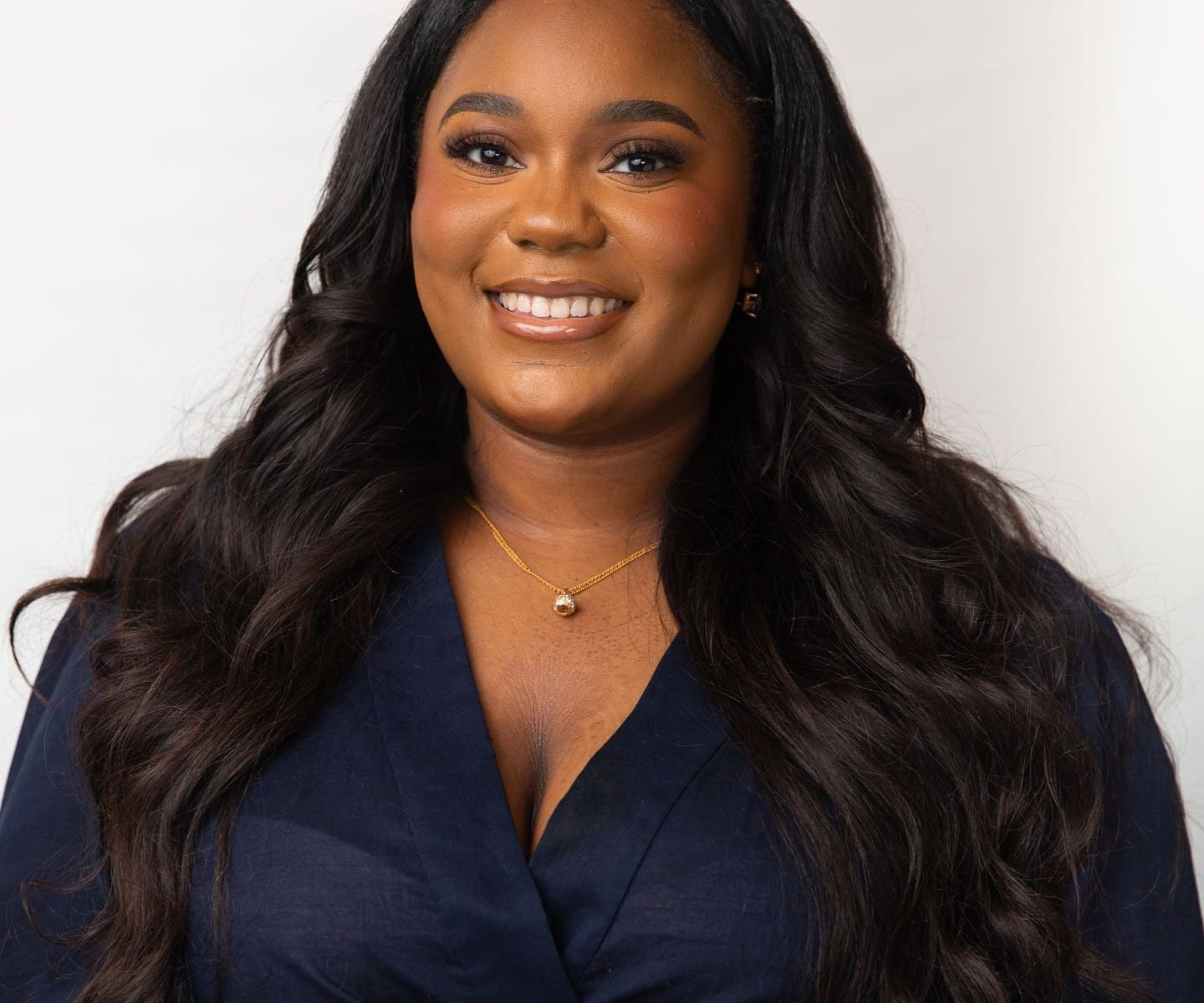
The summer after her first year at GW – entirely online – Deseree Chacha spent three weeks in Tanzania, to visit her grandmother and other family members. “I am a first-generation Tanzanian-American, and I think of Tanzania as home,” she says. “I definitely have taken an international journey to the Elliott School.”

Chacha began her studies thinking she would major in psychology, yet even in the first year she found herself drawn to classes that focused on African history, culture, and politics. This interest crystalized as she traveled across Tanzania, from Dar es Salaam to Arusha to Zanzibar. By the time she returned to GW for sophomore year, she knew she would change course and study international affairs at the Elliott School.

“I am the type of person who wants to take an academic route to learn more about my identity,” Chacha says. “The trip was the moment when I realized I could actually pursue this.”

As the oldest of three children, Chacha was sensitive to the financial burden her parents took on when she started her undergraduate studies. In November 2022, part of this burden was lifted when Chacha received a scholarship through the Elliott Equity Fund, established in spring 2022 to encourage students from all walks of life to pursue their dreams.

“I was so elated to tell my parents I got this award. I knew this would relieve some of the pressure on my parents and even my siblings,” she says. And there is another dimension, as well. “This award shows that the Elliott School recognizes the need to take specific action in regards to equity.”

The field of international affairs benefits greatly from diversity among its ranks, says Rebecca
Brown Thompson, MA ’91. Thompson, a member of the school’s Board of Advisors, went from
the Elliott School to a distinguished 28-year career as a Foreign Service Officer with the US State
Department. Over the years, she continually sought to develop inclusive teams.

“The more diversity we can bring to the table during policy deliberations, the more we can be
confident we’re developing foreign policy that is well thought out,” she said, and added, “When
we have diverse teams representing the United States overseas, it reflects the values of our
country.”

For Thompson, the Elliott Equity Awards are one way to remove barriers to equity and inclusion
and ensure that the “best and brightest students out there, no matter what their backgrounds,
choose the Elliott School.”

The view from inside the classroom mirrors Thompson’s experience in the field. “To resolve the most pressing challenges facing our interconnected world, we need to tap into the full measure of talent available, bringing to the debate the widest possible range of perspectives and ways of thinking,” says Elliott School Professor Jennifer Brinkerhoff.

With more than 40 percent of GW students qualifying for need-based aid, the Elliott Equity Fund Awards are a powerful game changer – for Deseree Chacha, her fellow awardees, and future award winners.

Or, as Chacha puts it, “the advancement of diversity in international relations will greatly assist key advisors and global leaders to foster peace and unity.”

Visit the Elliott Equity Fund webpage to learn more and donate today. 

Elliott Student Spotlight: Elise Bourmatnov

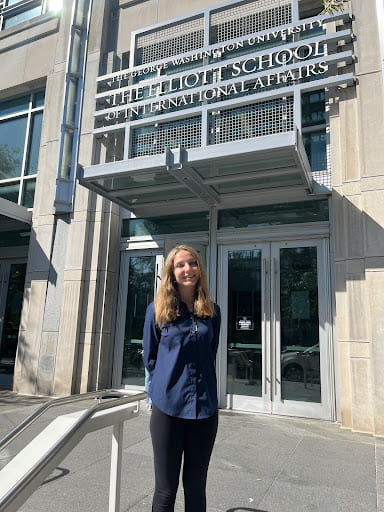
                                        The Elliott school is honored to welcome in the new class of 2026 for the                                            2022-2023 academic year. With an incoming undergraduate class of just                                            under 550 students and a graduate class of just over 250 students. We                                                decided to catch up with a first year Elliott student Elise Bourmatnov to see                                          how students are adjusting to life at GW. 

                                      What made you choose GW?

                                       When I was making my college decision it was a question between staying                                           in state or going all the way out to DC and in the end I chose GW mostly for academic reasons and for new opportunities. It was hard to choose to live so far away, but the city atmosphere was always exciting and there wasn’t a program that really catered to my interests in Seattle

What school were you in between?

I was in between the University of Washington and GW. I had two sisters that went there one just graduated with a public health degree and my other sister is a junior at the moment and she is studying psychology.

Are you interested in Greek life?

Yes, both of my sisters went through the greek system in Washington and I think interested in joining greek life here. 

I’m pretty sure I want to join the panhellenic sororities. I don’t have a favorite yet but I’m interested to look into them and see which one I would like to be in, especially during formal recruitment in mid-January.

What’s your favorite thing you have done in DC so far?

I think the most exciting thing I have done was taking a White House tour. I actually had to contact my congressional representative about 3 months in advance to request the tour. I took a red eye here and went straight to the White House so it was pretty tiring, but it was really cool and I got lots of good photos.Also, going around Georgetown was super cute also there was a lot of shops and food, so that’s definitely some place you have to go if you are in DC

What’s the best food you have had here?

I have had the best food in Western Market. There is a shawarma spot I went to with my friends and it was super good. I had never tried it before and it was so delicious and at a good price too.

What’s on your bucket list?

If there are more opportunities for activism, demonstrations and that sort of stuff it would be really interesting to be a part of. 

Do you have any favorite or interesting classes so far?

I think my education here has been general so far just doing history, economics, French, and international affairs. French is definitely a challenge because at my high school we did not have our classes instructed in the french language, but here class is entirely in French. There is a learning curve, but it’s making me improve a lot in French and especially in speaking.

 I had also never taken an economics class before but so far it’s interesting. The math component is a nice break from the rest of my classes which are reading focused. Of course international affairs is the most interesting class because my professor Michael Brown is super passionate and  engaging.

Anything that surprised you now living as a student at GW?

I definitely feel more connected with the city. While I was touring I thought that because I was on a college campus it would be very enclosed. However I actually feel I’m always leaving campus and finding new restaurants with new things to do. I love all of the beautiful architecture and monuments that have not gotten old yet.

What is the social scene like at GW in your opinion?

Some people say there are no parties at this school, however I have seen an article or two saying that this is a party school. In my experience it’s kinda in the middle, there’s definitely some night life but it’s not crazy. Because we are in the middle of the city there is a bit of a space limitation. I have signed up for George’s army and I am excited to watch basketball and other sports throughout the year.

What future goals do you have in Washington?

I currently have a federal work study job in the public affairs office of Elliot. I am still figuring out my concentration within international affairs at the moment so, I don’t quite know what internships I would like yet. I am considering a concentration in international development or international economics.


GW Professor in the Spotlight IERES Director Marlene Laurelle Draws Attention to Ukraine

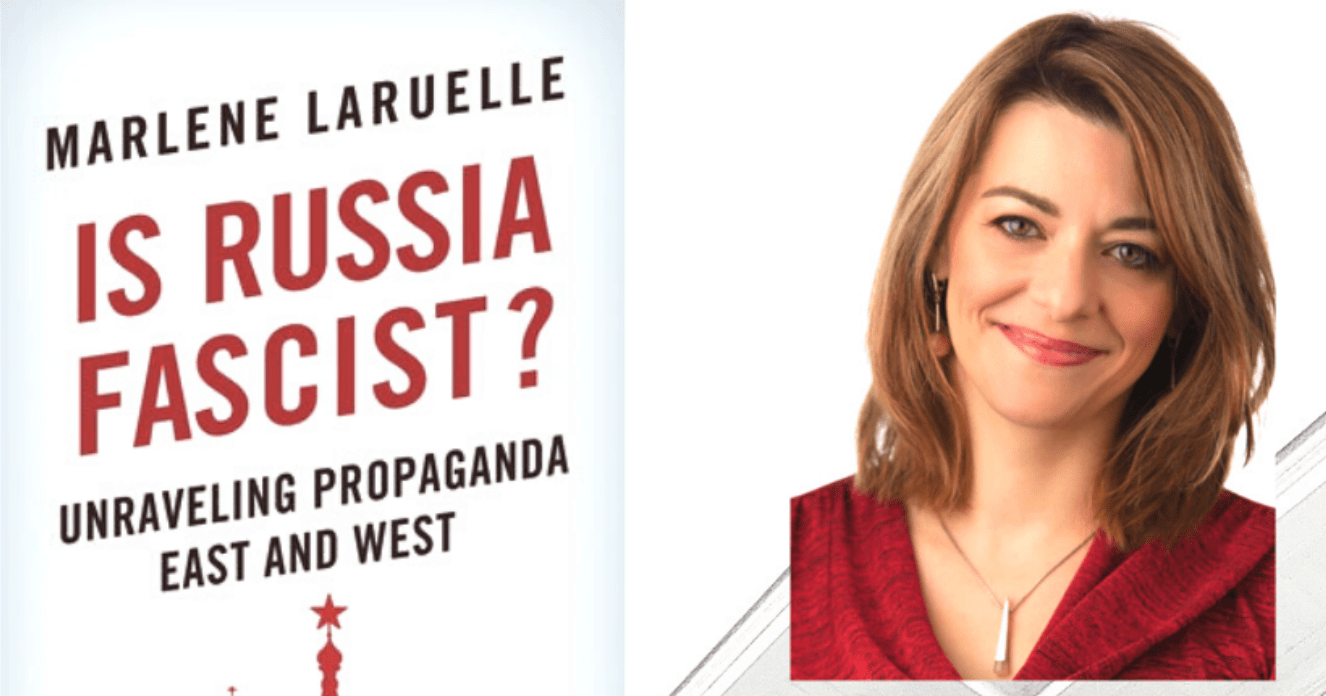
In a recently published New York Times op-ed, Dr. Marlene Laruelle explores the brewing domestic political crisis in Russia and describes a country starkly divided. “In the wake of a stunning counteroffensive in which Ukrainian forces reclaimed over 1,000 miles of territory, Russia is uneasy,” says Laruelle.

Marlene Laruelle, Ph.D., is a Research Professor of International Affairs and the Director of the Institute for European, Russian and Eurasian Studies (IERES) within the Elliott School of International Affairs. The Institute’s primary mission is to “promote and support the study of Europe and Eurasia through research, courses, events, and publications.” 

Dr. Laruelle’s research focuses on illiberalism, the transnational far-right, and the Russian ideological landscape. She is the author of Is Russia Fascist? Unraveling Propaganda East and West where she explores accusations of fascism toward Russia and expertly examines the Russian domestic scene and the Kremlin’s foreign policy rationales. 

“Among citizens, interest in the war and the accompanying rally-around-the-flag effect are waning,” Dr. Laruelle notes. Protests against Putin’s 300,000 troop mobilization have engulfed parts of Moscow, St. Petersburg and 36 other cities, resulting in the arrests of over 1,300 on Wednesday night. This year alone, nearly 4 million citizens have fled Russia, including up to 15,000 millionaires.

Since the war began in February, 2022, the media has sought out the institute and Dr. Laurelle to provide expert analysis of the conflict. On March 1, Dr. Laurelle was one of five panelists that included former Ambassador and Elliott alumnus, Kurt Volker, in an event titled  “Conflict in Ukraine” a mere six days after Russia attacked that country.

In mid-March, IERES, PONARS Eurasia, and the Petrach Program on Ukraine hosted Ukrainathon, a 24-hour “marathon” online event on Russia’s invasion of Ukraine. The program featured continuous 15-minute talks from more than 90 international experts to provide comprehensive insight into the war from multiple angles. 

Recently, GW alumna, Jenna Segal, B.A. ‘98 and her husband Paul wanted to assist Ukrainains in need. Working with Elliott School Dean, Alyssa Ayreas, and Dr. Laurelle, the Segals’ established a Fund for Scholars Affected by the War in Ukraine and is run by the IERES and headquartered at the Elliott School.

According to the report in GW Today, The Segals’ gift will support scholars based in Ukraine or who were forced to flee the country. Each semester for five years, the Elliott School will welcome three visiting fellows to campus, with compensation commensurate with their experience. GW President Mark S. Wrighton said, “The establishment of this fund at the George Washington University will undoubtedly further the Elliott School of International Affairs’ important global reach and impact.”

Students Place Second at Schuman Challenge

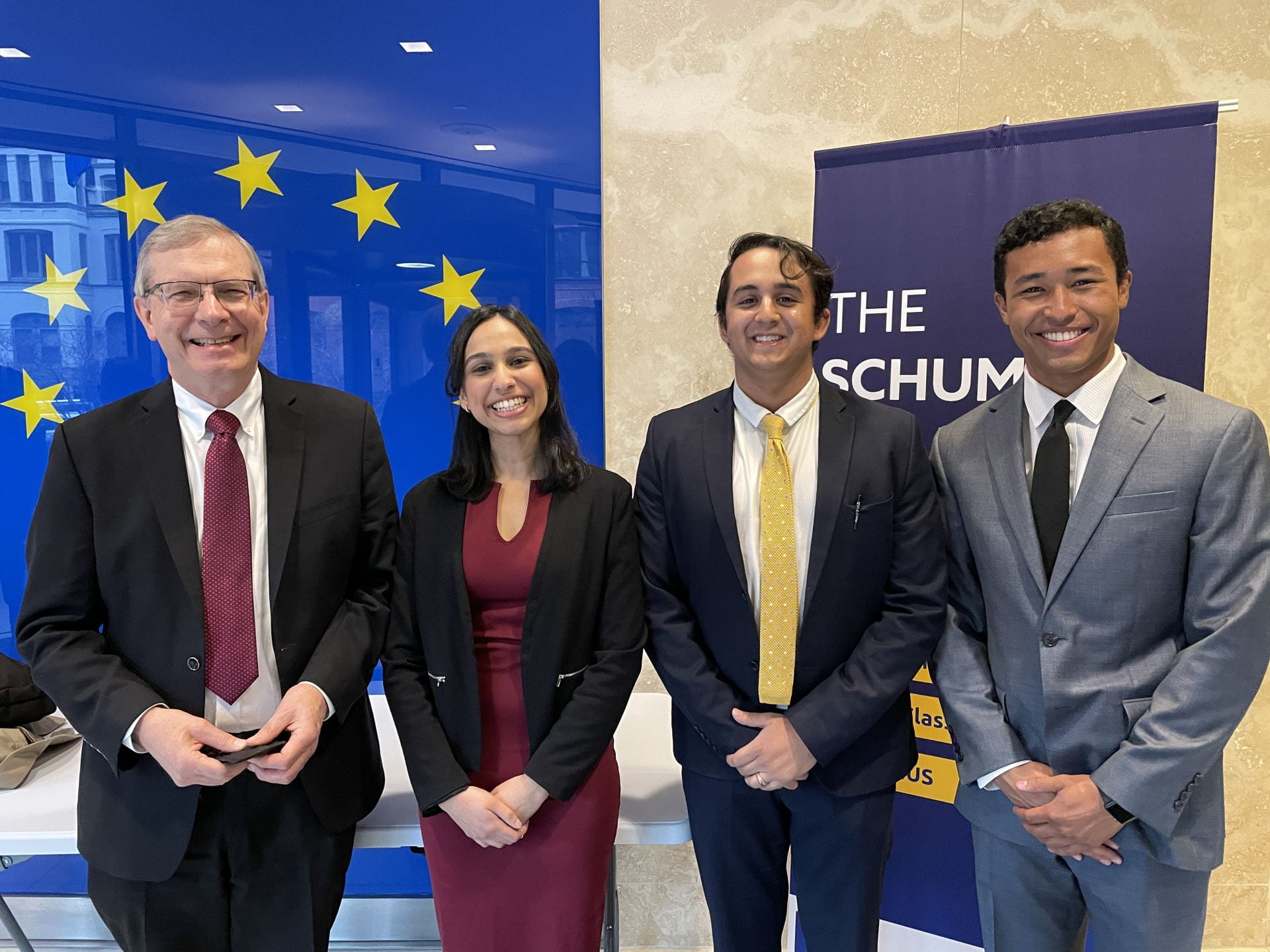
Schuman Challenge Participants with Chris Kojm

GW competed in the Schuman Challenge at the European Union mission and came in second place out of 22 competing schools. The team featured Anisha Sahni (senior, double major in political science with a public policy focus and Women’s, Gender and Sexuality Studies; Master of Public Policy), Rushabh Patel (junior, international affairs and political science major) and Kenzo Murray (senior, international affairs major), coached by Christopher Kojm, the director of the Elliott School’s Leadership, Ethics and Practice Initiative.

The competition, which took place April 7 and 8, annually invites teams of three to four undergraduate students to respond to a topic impacting transatlantic relations and present before a panel of judges. It is a two-round competition, and teams from across the U.S. deliver 10-minute presentations on a pressing foreign topic issue. This year, the topic was “How should the EU and U.S. cooperate in Afghanistan following the U.S. military withdrawal?” The students prepared and delivered a 10-minute presentation and answered questions from a panel of judges including the EU Ambassador in Washington. Below is a Q&A with Murray and Sahni. 

Q: How much preparation went into the Schuman Challenge? When did you learn of your topic?

Murray: A significant amount of preparation went into the Schuman Challenge. We first began discussing the topic in January after returning from winter break. Understanding the on-the-ground situation in Afghanistan has been difficult since the U.S. military withdrawal. NGOs in Afghanistan do not publish information about their activities so that they can protect their personnel and the people they are helping. We really got to work after spring break, meeting usually twice a week for a few hours to revise our proposal and do more research. 

Sahni: The Schuman Challenge involved extensive preparation. To discuss Afghanistan requires a deep level of understanding regarding the history of imperialism and conflict and the diversity of Afghan communities. I learned a great deal about these issues as well as the theoretical foundations of how to address broader issues of humanitarian crisis, economic collapse, and human rights.  

Q: How did your group answer the question presented? 

Sahni: Our group came up with a two-pronged policy approach to address the question. We first addressed the immediate humanitarian crisis facing Afghan civilians by advocating for an aid distribution model that centers local actors and creates oversight of the aid distribution process. Our second policy was designed to address the broader financial crisis in Afghanistan through the privatization of central bank functions to aid in economic development. This part of our proposal is based on the advocacy of Alex Zerden.

Q: What was the team dynamic like? 

Murray: Working with Anisha and Rush was a fun experience. Anisha was best able to speak to the conditions for women and on human rights, Rush talked about the economic tools we could use to get money into Afghanistan, and I thought about the overarching picture. We are all very busy so there were many late nights and early mornings doing research, FaceTiming to run ideas one another, and practice runs. I’d like to add that our faculty advisor Christopher Kojm in the Elliott School was a tremendous help, and we could not have been successful without his mentorship. We had multiple practice sessions with Professor Kojm where we rehearsed the presentation, engaged in Q&A, and got valuable feedback on our content and presentation style. In addition, our teammates Yaseen Shah (sophomore), Sean O’Neil (2021 grad), and Hailey Knowles (2021 grad), and coach Paul Hayes also helped us rehearse the presentation and gave constructive feedback on our proposal. They, too, were integral in our success at the Schuman Challenge. 

Q: How will the experience of delivering a nuanced presentation in front of judges, including the EU ambassador in Washington, prepare you for your future?

Murray: The experience of presenting before leading scholars, policy practitioners, and the Ambassador to the European Union gave me confidence in my public speaking abilities and will serve to remind me what policy makers and foreign policy experts are looking for: succinct answers that get to the point. I will remember how my teammates and I handled the presentation and Q&A in future situations where I have to present before someone or a group of people. 

Sahni:  This process was an absolute honor to be a part of, and I learned so much from the esteemed judges who took the time to listen to our presentation. I learned from this process the importance of providing direct and straightforward policy proposals that are well-organized when presenting in front of stakeholders on important issues.  

Elliott School M.A. Candidate and Rosenthal Fellow Will Work for House Foreign Affairs Committee This Summer

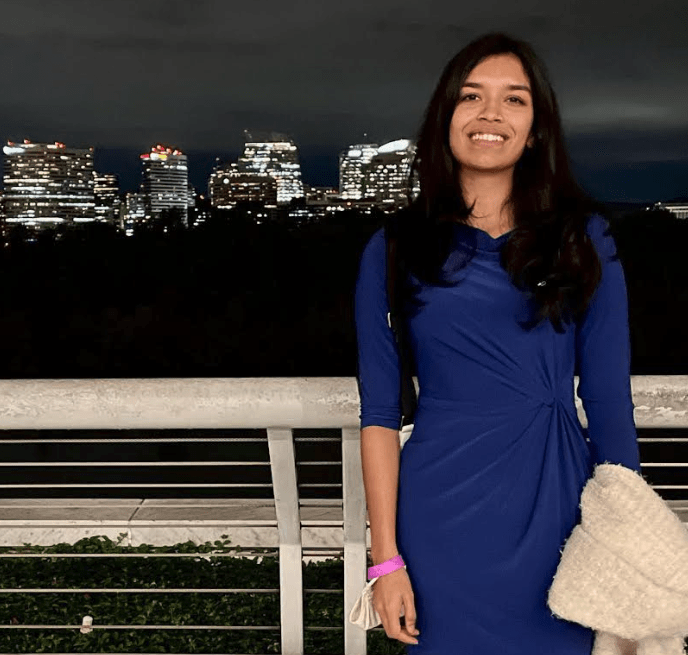
MA Candidate Medha Prasanna

Medha Prasanna has spent the bulk of her graduate studies at George Washington University learning about international organizations as well as Asian history and politics. But this summer, she will spend her time on Capitol Hill working for the United States Congress. 

The Elliott School of International Affairs M.A. candidate was selected as a prestigious Harold Rosenthal Fellow, providing summer funding and work opportunities in a congressional or executive branch office to students demonstrating outstanding commitment to international affairs and interest in public service. Prasanna, who begins her post on May 23, will be a fellow for the House Foreign Affairs Committee’s Asia Pacific Team, where she will spend much of her time doing general research.

She understands the fellowship is about governance in the U.S. and therefore can be difficult to answer as to why an international student from India studying policy of another region wants to work in the U.S. government. But she believes what happens in the halls of Congress is pivotal to the geopolitical scene. 

“In a sense, what America does has an effect on everybody in the world,” she said. “I feel like if I’m contributing or if I’m in public service to the U.S. in some way, that’s going to have a ripple effect that affects my country and other countries.

“Being a global citizen is sort of what the fellowship stands for.”

The fellowship was established in 1977 to honor the memory of Harold Rosenthal, a Senate staff member who at age 29 was a victim of a terrorist attack while on duty. It is a program of the Partnership for Public Service, a nonprofit, nonpartisan organization striving for a more effective government for American citizens. 

Prasanna, who attended Ashoka University near Delhi, India, before arriving at GW, has determined through her studies the importance of looking at international relations through regional approaches. While she believes there is merit in being an expert of one country, she sees even more value in observing how nations react to one another. 

In terms of the Asia Pacific, specifically, Prasanna feels it is the next hub when it comes to global problems such as climate change, pollution, cybersecurity, backsliding democracies, land and maritime conflicts. She understands how supply chains in the region are critical to the normal functioning of a global society. Having deep knowledge and understanding of how the U.S. government works will be beneficial whatever career she eventually pursues. 

After graduation, Prasanna has ambitions of working with an international organization in hopes of traveling to different places to better understand local people and policies. But with how much influence U.S. foreign affairs can have on the geopolitical structure, Prasanna is excited to spend the summer learning the nuances and intricacies of the House Foreign Affairs Committee and U.S. government in general.

“I think Congress is very important to American foreign policy,” Prasanna said. “I just want to understand when there’s a crisis, what is the legislative response; what are the processes? I want to learn now so I can navigate these things better when I’m in an international organization myself.” 

She already has government and international organization experience as she is currently a public information intern at the United Nations, and she was a Student Association graduate senator-at-large. Prasanna is also pleased with the value of her GW education, shouting out Elliott School faculty member David Shambaugh as a particular person of influence. 

If her attention to detail is any indication, Prasanna fits the bill of being a future civic leader. She found out about the fellowship through an email from the Elliott School’s Graduate Student Services. She makes sure to read everything that comes through her inbox, which may very well put her in the minority among her peers. Because of this diligence, however, she found what could be a life-changing and career-defining opportunity. 

Once she applied, GW nominated her to the fellowship, which then set her up with standard placement interviews. She found out her destination for the summer at the end of April. The fellowship will end Aug. 19, just before the fall semester begins. 

She is well on her way to a career seeking to improve the lives of others, and she’d like to start by encouraging other GW students who have faced rejection—which she did before getting her big yes—to stay the course and continue applying for opportunities.

“You might hear a lot of no’s in Washington, but no’s are a part of the process and often lead to something better,” she said.

And, of course, always read the fine print in emails. 

Note: Congressman Gregory W. Meeks (D-N.Y.)  is the first Black Chairman of the House Foreign Affairs Committee and will be the keynote speaker at the Elliott School’s graduation ceremony on May 13. In addition, GW Law alum Susan Ellis Wild, J.D. ’82, currently serves on the 52-seat House Foreign Affairs Committee. The Democratic Congresswoman from Pennsylvania will deliver the keynote address at the Law School Diploma Ceremony on Sunday, May 15.

A Week at Elliott

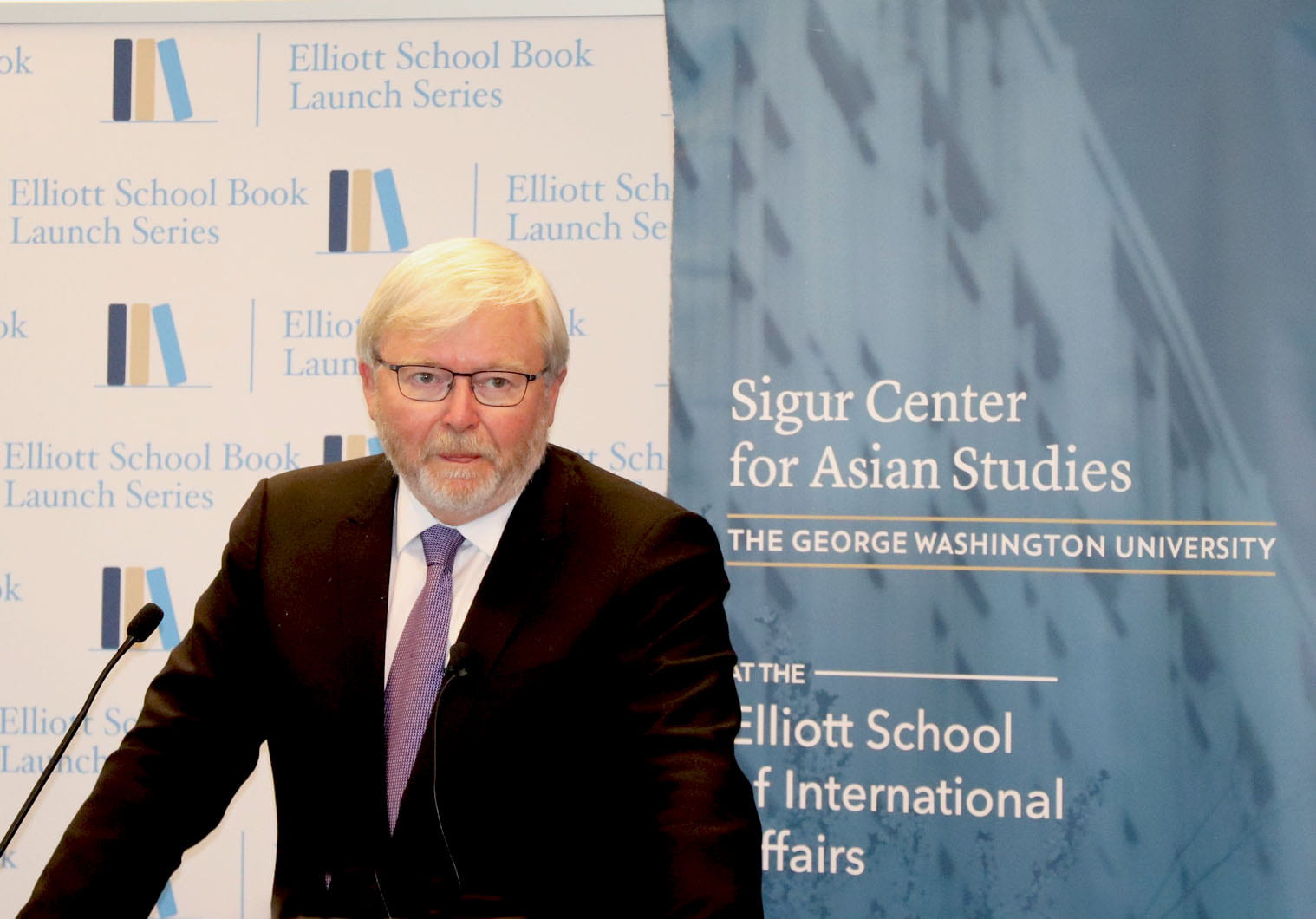
Kevin Rudd

Each semester the Elliott School hosts dozens of diverse events featuring distinguished speakers from all aspects of the international affairs community, all free to students and often open to the public and to the media. In just one recent week alone, the Elliott School hosted Somaliland President Muse Bihi Abdi, former Australian prime minister, Kevin Rudd on the future of conflict between China and the US, the Mayor of Los Angeles on the growing impact of non-state actors on international affairs, former Joint Chief of Staff General Richard Myers on the importance of character in leadership, and a discussion about the significance of Arab League state, Qatar, hosting the upcoming World Cup Soccer Championships. Several of these events were recorded. 

Visit the links below to see the recordings of these and other prestigious events held at the Elliott School.

(En)Gulfing the Global Game: World Cup Qatar 2022 

The Dean’s Speaker Series “What’s Next in Foreign Affairs” hosted Los Angeles Mayor Eric Garcetti

Kevin Rudd, the former Prime Minister of Australia and current President and CEO of the Asia Society, for a discussion of his new book The Avoidable War: The Dangers of a Catastrophic Conflict between the US and Xi Jinping’s China.

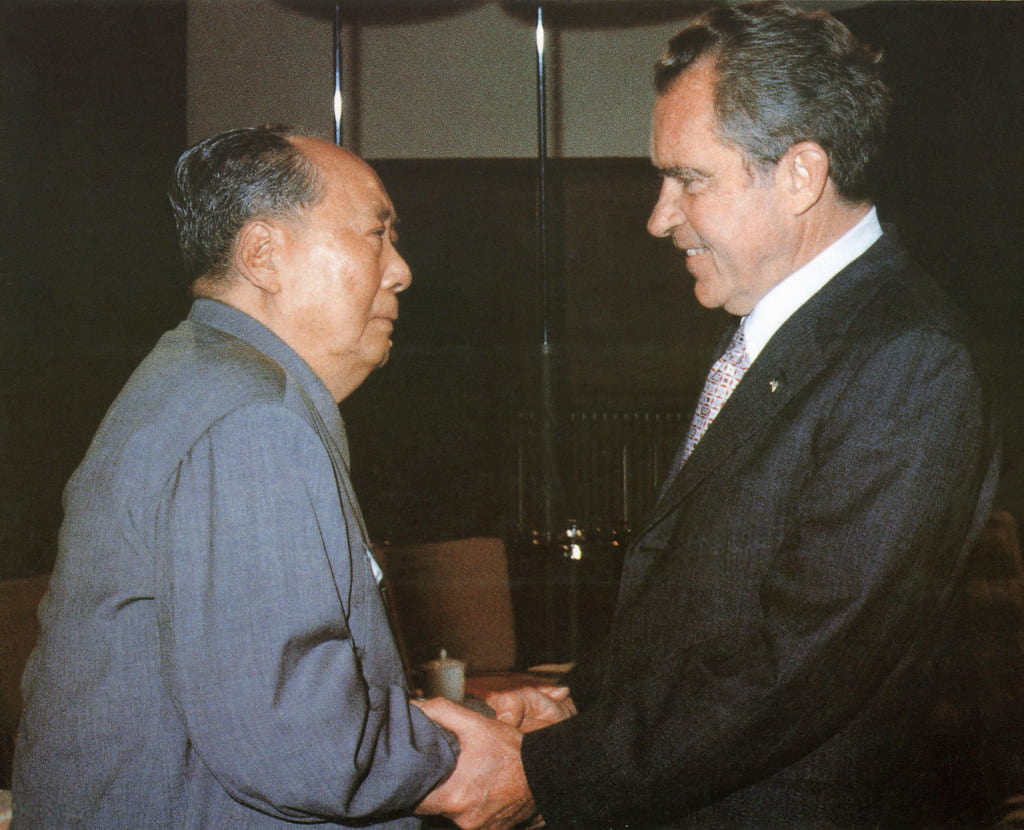
50 years later: Richard Nixon’s Historic Visit to China

Nixon China visit
Nixon China visit

Two Elliott School faculty members who are leading international experts on U.S./China relations offer commentary on the 1972 foreign affairs breakthrough.

President Richard Nixon made one of the most significant foreign visits in the history of the United States 50 years ago when he traveled to the People’s Republic of China Feb. 21-28, 1972—ending two-plus decades of no communication or diplomatic ties between the two nations. 

GW Today sat down with two leading international experts on U.S./China from the Elliott School of International Affairs to discuss the trip to Beijing 50 years later.

David Shambaugh, the Gaston Sigur Professor of Asian Studies, Political Science and International Affairs and director of the China Policy Program, served the State Department and National Security Council during President Jimmy Carter’s administration. He also served on the board of directors of the National Committee on U.S./China Relations and is a life member of the Council on Foreign Relations, U.S. Asia-Pacific Council and other public policy and scholarly organizations. Before GW, he was senior lecturer, lecturer and reader in Chinese politics at the University of London’s School of Oriental and African Studies, where he also served as editor of The China Quarterly.

Robert Sutter, Professor of Practice of International Affairs, had a government career that lasted from 1968 until 2001. He served as senior specialist and director of the Foreign Affairs and National Defense Division of the Congressional Research Service, the national intelligence officer for East Asia and the Pacific at the U.S. Government’s National Intelligence Council, the China division director at the State Department’s Bureau of Intelligence and Research and professional staff member of the Senate Foreign Relations Committee.

Shambaugh and Sutter were asked questions, some the same and some different, separately for this article.

Q: At the time, what was the significance of Nixon’s visit to China? 

Shambaugh: President Nixon’s visit to China in February 1972 was described at the time as “the week that changed the world.” While perhaps hyperbole, there is indeed truth in this characterization—for three principal reasons. First, it ended the 22-year estrangement and total lack of contact between both the governments and the people of China and the United States. It would take another seven years before official diplomatic relations would be consummated under the Carter administration—where I worked on the China staff of the National Security Council staff at the time—which in turn opened a wide variety of direct ties between our two societies, but the Nixon visit catalyzed the process. Second, with the American opening to China, other governments around the world, which had been part of the previous U.S. policy to isolate and contain China, now were free to open their own relations with the People’s Republic of China—thus, in a real sense, the Nixon visit not only opened U.S./China relations, but it also did much to open China’s own doors to the world that had been previously almost completely isolated. Third, the Nixon visit was a strategic stroke of genius and fundamentally altered the balance of power in the so-called strategic triangle (U.S., China, Soviet Union) at the time, aligning America and China against Moscow. That, in turn, led over time to the weakening of the Soviet Union, its collapse and end of the Cold War.

Q: How was the event viewed in the U.S. at the time? What about in China? 

Sutter: It was a big news item, and it was widely applauded. Everyone thought this was a great idea. The Chinese were on their best behavior. It was all very cordial. And it was in the interest of both sides to look like they were very close. China was desperate. And China was under the gun from the Soviet Union. It was very much in the Chinese interest because they were very worried about the U.S. and Soviet Union.  

Q: Did Nixon’s China policy and visit facilitate the creation of modern China? 

Shambaugh: Indirectly, yes. Nixon’s visit facilitated China’s broader opening the world, notably the Western world. This brought China in direct contact with the world’s most developed economies—which have been central to the foreign investment, technology transfer, and professional exchanges that have all contributed much to China’s dynamic economic growth since. But it also took the death of [Chinse President] Mao [Zedong] and the coming to power of Deng Xiaoping in 1978 to relax the repression and xenophobia within China, so the country could take advantage of the door that Nixon and Mao initially opened.

Q: What would be comparable to Nixon’s visit today?

Sutter: I just want to reiterate the fragility of China (in 1972). This was a dangerous mission. They were taking a risk. But they must have had enough evidence that they felt the president could be secured, and they could get him out if they had to. It was like going to North Korea today. China then was a lot like North Korea today. Very secretive. There’s so many things you didn’t know. It was a gamble, in a way.

Q: Why does the Nixon visit still fascinate so many? And why is it important for students today to learn about it? 

Shambaugh: The Nixon visit continues to fascinate, in part, because it was such great public theater—because it took place on live television. Here was a society (Communist China) that had been completely closed off from the world since 1949, having recently been convulsed by the cultural revolution (from 1966-76), literally opening itself up for others to peer inside. The drama of Nixon meeting Mao [Zedong], being feted in the Great Hall of the People, touring the Great Wall and signing the Shanghai Communique was all riveting theater. As for students today, I am currently teaching my graduate-level U.S./China relations course this semester, and we watched the film ”History Declassified: Nixon in China” earlier this month, and I also invited to class Winston Lord—who was Nixon’s and [former Secretary of State] Henry Kissinger’s close aide. He participated in Kissinger’s secret 1971 trip to Beijing, the Nixon visit itself, played a key role in negotiating the Shanghai Communiqué, and later became America’s ambassador to China from 1985 until 1989. The students loved it. So, yes, the Nixon visit is still very much alive, at least in my class in the Elliott School. As for what students can still learn from it, I would say that no matter how great a gulf or differences can be between governments or peoples, there is always the possibility of improving ties. This is something we should remember about U.S./China relations when they are as strained as they are today.

Q: Nixon self-described the visit as a “week that changed the world.” Looking back 50 years later and where the two countries are now, is that statement accurate, far off, or somewhere in the middle?

Sutter: It fundamentally changed the world at the time, but the world has also changed since, and China changed. Maybe the United States has changed too, but China has definitely changed. It’s just more powerful. We never knew, we outsiders never knew what China would do if it became very powerful. There was no evidence to back that up. But now we have evidence of it. That changes our perceptions and, and that’s what’s happened over the last few years.